How High Should Your Scissor Lift Reach? Project Height Guide
What Height Scissor Lift Do You Need for Your Project?
A crew shows up to install ductwork in a warehouse with ceilings pushing 30 feet. The lift on the trailer tops out at 26 feet of platform height, and once you factor in a worker’s reach, it still leaves a gap at the highest runs. Now the job stalls while someone scrambles to swap machines, and half a day of billable work slips away. That gap between the height you rented and the height you actually needed is the whole reason this question matters. Pick too short and you can’t finish the work. Pick too tall and you overpay for capacity you never use.
Choosing the right scissor lift height comes down to how high your crew needs to work, where the job happens, and what the ground looks like. Get it right and the machine reaches everything on the first try. Get it wrong and you lose time, money, and momentum. This guide walks through the common height ranges, the difference between platform and working height, indoor versus outdoor use, and how to match a lift to your job so you rent or buy the right one the first time.
The mistake many crews make is focusing only on the lift’s maximum height instead of looking at the full working situation. The actual requirement depends on more than the ceiling or installation point; it also includes the operator’s reach, the size of the platform, the tools and materials being carried, and how much room the machine has to move around the site. A lift that looks tall enough on paper may still fall short once real job conditions are considered. Taking the time to calculate the required working height before renting or buying prevents delays, avoids paying for unnecessary capacity, and helps keep the crew working efficiently from start to finish.
What height scissor lift do I need? Start by calculating the maximum working height required for your project.
Platform Height vs. Working Height
Before looking at any lift range, it is important to understand the two height numbers manufacturers commonly list, because confusing them is one of the biggest causes of poor equipment choices. Platform height refers to how high the actual deck of the scissor lift can rise from the ground. Working height adds the operator’s reach into the equation, usually estimated at about six feet above the platform because it accounts for the average standing worker reaching overhead while positioned on the deck.
Understanding what height scissor lift do I need helps you choose the correct platform height for the job.
This difference matters because the number on the specification sheet may not represent the true height your crew can work at. A lift with 26 feet of platform height typically provides around 32 feet of working height. If your installation point is at 30 feet, that machine should have enough reach, but a lift rated at only 26 feet of working height would leave the crew short. Always compare the working height to the actual location of the task, then confirm whether the manufacturer is listing platform height or working height. Taking a few minutes to check the correct measurement prevents choosing a lift that is either too small for the job or larger than necessary.
When deciding what height scissor lift do I need, consider both the working height and jobsite conditions.
Common Scissor Lift Height Ranges
Knowing what height scissor lift do I need is especially important when comparing indoor electric lifts with rough terrain models.
Scissor lifts are available in predictable height categories, and each range fits different types of work. Smaller lifts are designed for indoor maintenance, electrical work, and lower ceilings, while taller models are built for warehouses, commercial buildings, and large construction projects where crews need extended overhead access. Outdoor rough-terrain models often provide higher reach combined with stronger stability for uneven surfaces. Understanding where your project falls within these common height ranges helps narrow your options quickly and makes it easier to select equipment that matches both the height requirement and the working environment.
Determining what height scissor lift do I need before renting or buying can prevent unnecessary costs and project delays.
19 to 26 Feet: Everyday Indoor Work
This is the range most crews reach for on interior jobs. A 19-foot lift handles low-ceiling work like retail buildouts, office fit-outs, and light electrical or drywall. Step up to 26 feet and you cover standard warehouse ceilings, HVAC runs, and most commercial interior tasks. These lifts are usually narrow, electric, and easy to move through doorways and across finished floors, which makes them the workhorse for indoor construction and maintenance.
32 to 40 Feet: Higher Interiors and Light Exteriors
When ceilings climb or the work moves outside, this range takes over. A 32-foot lift reaches tall warehouse and industrial ceilings, while 40-foot machines handle high atriums, arenas, and multi-story interior work. Many models in this bracket are wider and heavier for stability at height, and some are built rugged enough for firm outdoor ground. If your job regularly sits above standard ceiling height, this is the range to weigh.
45 Feet and Up: Tall Exterior and Specialty Jobs
At the top end, scissor lifts reach 45 feet and beyond for the tallest work a scissor design can handle. These machines suit large exterior facades, tall structural steel, and big industrial sites where crews work well above ground. They are large, heavy, and almost always rough terrain models built for outdoor stability. Beyond this range, many contractors switch to a boom lift instead, since booms offer reach and articulation a scissor lift can’t match.
Indoor vs. Outdoor Use
Height is only half the decision. Where the lift will be used plays an equally important role in choosing the right machine. Indoor jobs typically favour electric scissor lifts because they produce zero emissions, operate quietly, and are designed to work safely on smooth, finished floors. Their compact size also allows them to fit through standard doorways, navigate narrow aisles, and manoeuvre easily in confined spaces such as warehouses, shopping centres, factories, and office buildings. For most indoor maintenance, installation, and construction tasks, an electric lift in the appropriate height range offers the best combination of efficiency, safety, and ease of use. By matching the lift to both the required working height and the indoor environment, operators can complete jobs more effectively while protecting floors and surrounding structures.
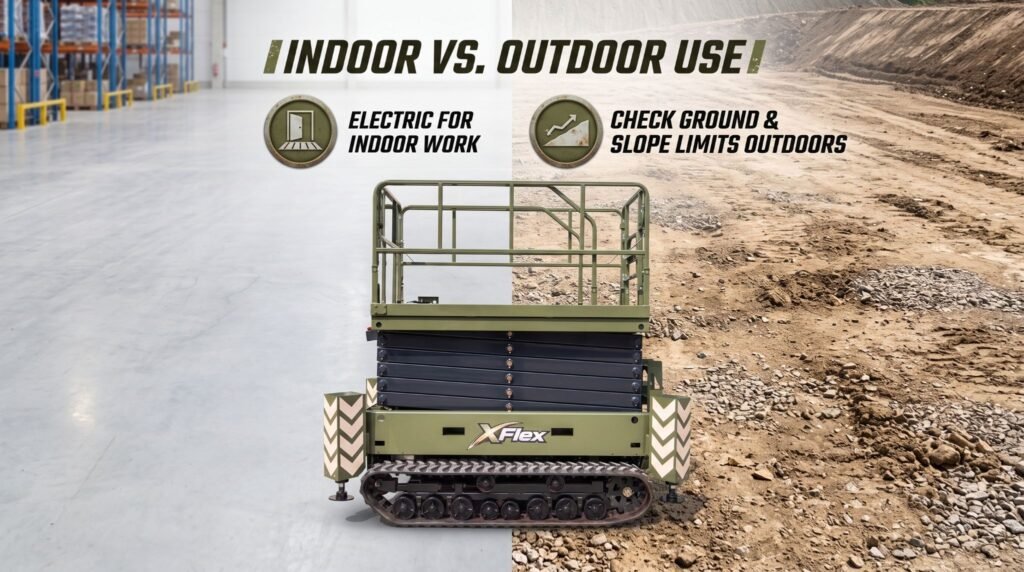
Outdoor jobs change the math. Soft, sloped, or uneven ground limits where you can safely raise a platform, and taller lifts get more sensitive to that the higher they climb. A machine that feels rock-solid indoors can become a hazard on a graded lot. Matching the lift to the surface matters as much as matching it to the height, and following manufacturer guidance on slope and ground limits keeps the crew safe.
Electric vs. Rough Terrain at Height
The taller and more exposed the job becomes, the more important the lift type becomes. Electric scissor lifts dominate the lower and mid-height ranges for indoor work because they are compact, quiet, and produce no emissions. Their smaller footprint makes them easy to maneuver through doorways, aisles, and finished spaces, while their design works best on smooth, level floors where stability is already built into the environment.
Rough terrain scissor lifts take over when the work moves outdoors onto dirt, gravel, construction sites, or uneven ground. Larger tires, increased ground clearance, and a stronger base allow them to travel and operate where an indoor lift would struggle. Many taller models, especially those reaching above 40 feet, are built as rough terrain units because greater height requires stronger stability when working outside. The best approach is to consider the surface conditions first, then choose a lift that provides the height and reach your crew actually needs.
Matching Height to the Job
Match the lift to the work you actually do, not the tallest job you can picture. Start by identifying the maximum height required for your everyday tasks, add a suitable working-height buffer, and consider the environment where the lift will operate. A lift that is too small can slow productivity, while one that is much larger than necessary can increase costs and reduce manoeuvrability.
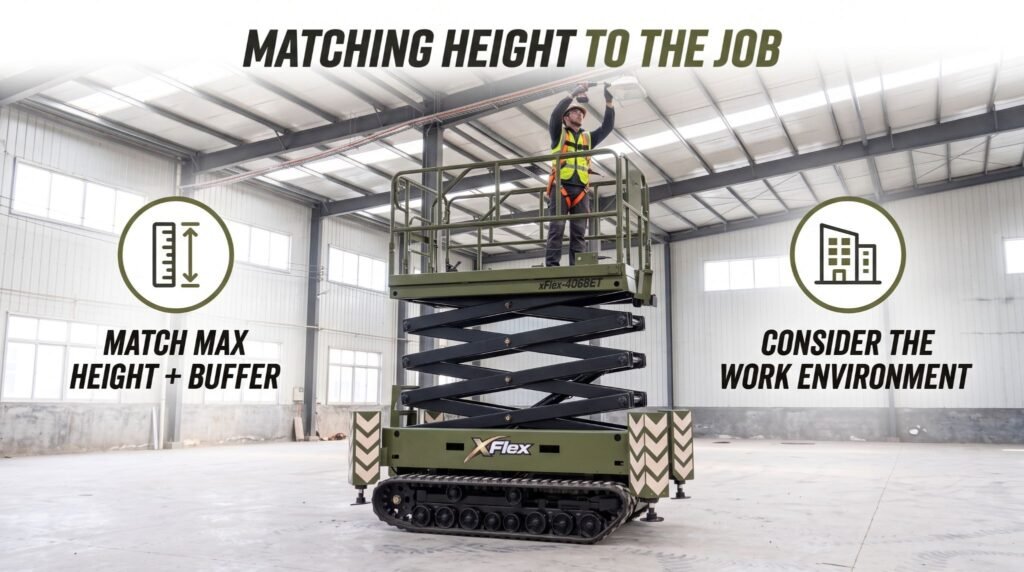
Look at the entire project rather than just one work area. If most tasks are completed at around 24 feet but a few sections require 30 feet, choose a lift that can safely handle your highest routine task. Having a little extra reach is helpful, but oversized equipment can make transport, setup, and operation more difficult. For occasional high-reach work, renting a larger model may be a more cost-effective option.
Also consider the types of projects your business handles throughout the year. Whether you’re working on construction, maintenance, electrical, painting, or warehouse applications, selecting a lift that matches your typical jobs will improve efficiency and reduce unnecessary expenses. By balancing height, site conditions, and future project needs, you can choose equipment that delivers the right performance without paying for capacity you rarely use.
Conclusion
Choosing the right scissor lift height starts with understanding your required working height, not just the platform height. Select a lift that can comfortably handle the tallest tasks you perform on a regular basis, and be sure to match the machine to your jobsite by choosing an electric model for smooth indoor floors or a rough-terrain model for uneven outdoor surfaces. The right balance of reach, manoeuvrability, and capacity will help improve productivity, enhance operator safety, and avoid unnecessary equipment costs. By considering both your current projects and future workload, you can invest in a scissor lift that delivers reliable performance and long-term value. When you’re ready to choose the right equipment, consult a trusted equipment specialist who can recommend the best solution for your specific applications.
Frequently Asked Questions
What’s the difference between platform height and working height on a scissor lift?
Platform height is how high the lift deck rises, while working height includes the operator’s reach above the platform. A 26-foot platform lift typically provides around 32 feet of working height, depending on the operator and working position.
What height scissor lift do I need for a standard warehouse?
A 26-foot platform lift often works for many standard warehouse ceilings and overhead installations, but the correct choice depends on the actual working height needed. Always check the task height and the manufacturer’s listed specifications before choosing a lift.
Can I use an electric scissor lift outdoors?
Electric scissor lifts are best suited for smooth, level surfaces such as indoor floors or finished areas. For outdoor jobs with uneven ground, slopes, dirt, or gravel, a rough terrain model is usually the better option for safe and stable elevated work.
