
Forklift battery maintenance
Warehouse Forklift Battery Life and Maintenance Requirements
Every warehouse shift depends on forklifts completing the same basic cycle repeatedly: lift a pallet, travel through the aisle, place the load, reverse, and move to the next task. Over several hours, that constant movement places steady demand on the battery. Reliable stored power keeps the truck available for receiving, picking, storage, and shipping, while reduced capacity can slow operations and create unexpected charging stops.
Battery condition has a direct connection to daily forklift productivity. Proper charging helps preserve usable capacity, while clean connections and appropriate maintenance support dependable power delivery. Temperature, operating intensity, charging frequency, and battery age can also influence how much energy remains available during a shift. Small maintenance issues may not appear serious at first, but repeated neglect can gradually shorten runtime and service life.
Long-term battery performance comes from consistent care rather than occasional attention. Following the correct charging procedure, inspecting terminals and connections, checking serviceable battery fluid levels when applicable, and keeping the battery clean can help prevent avoidable problems. Regular checks also make it easier to identify declining performance before it becomes a major interruption to warehouse material handling.
Battery Type Affects Maintenance
The first step in maintaining a forklift battery is knowing what kind you have, because maintenance requirements depend on the battery technology. Flooded lead-acid batteries, long the standard in warehouse fleets, need regular attention to electrolyte levels, terminals, and overall condition. Many sealed and lithium-ion systems work differently, with service requirements that can be far lighter or simply different in nature. Treating every battery the same is a mistake that either wastes effort or misses critical care.
Because the differences are real, the battery manufacturer’s specific instructions are always the right reference point. Those instructions tell you exactly what your battery needs, how often, and what to avoid. Building your maintenance routine around them, rather than around habit or assumption, ensures you’re giving the battery the care it actually requires and none of the care it doesn’t.
Key takeaway: Maintenance requirements vary by battery technology, so identify whether you have flooded lead-acid, sealed, or lithium-ion and follow the manufacturer’s specific instructions.
Charging Habits Influence Battery Life
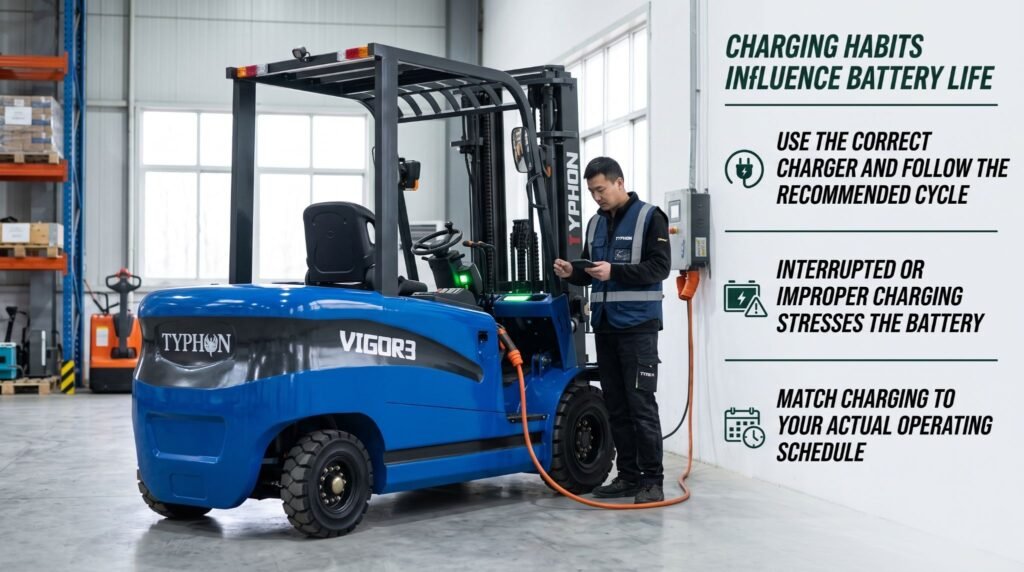
Few things affect a forklift battery’s lifespan as much as how it’s charged. Proper charging practices protect long-term performance, while poor habits quietly wear the battery down over time. The foundation is simple: use the correct charger for your battery and follow the recommended charging cycle. Repeatedly interrupting a charge or improperly extending it places unnecessary stress on the battery, and that stress accumulates into lost capacity and shortened life.
Charging also has to fit the way the forklift is actually used. Charging procedures should match both the battery type and the operating schedule, so the battery is ready when the next shift begins without being mistreated to get there. A charging approach that suits an occasional-use forklift may not work for one running continuously, which is why aligning charging with the real demand matters. Get this right, and you protect both today’s runtime and years of dependable service.
Key takeaway: Use the correct charger, follow the recommended charging cycle without interrupting or overextending it, and match charging to your battery type and operating schedule.
Electrolyte Levels Need Attention
Flooded lead-acid batteries require regular electrolyte inspections, and this is one of the most important checks for keeping them healthy. The electrolyte protects the battery plates, and when levels drop too low, those plates can be exposed to damage that permanently reduces capacity. Regular inspection catches low levels before they cause harm, which is exactly why it belongs in a standing routine.
Watering has to be done correctly to help rather than hurt. Add water according to the manufacturer’s instructions, using the correct type of water and topping up at the proper point in the charging cycle. Timing matters here, since watering at the wrong stage can lead to overflow or leave levels short. Following the manufacturer’s procedure every time keeps the plates protected and supports the consistent operation the forklift depends on.
Key takeaway: Flooded lead-acid batteries need regular electrolyte checks, with water added by the manufacturer’s procedure at the correct point in the charge cycle to protect the plates.
Clean Connections Support Power Delivery
Even a healthy battery can’t deliver its power if the connections are compromised. Terminals, cables, and connectors all need to stay clean and secure, because corrosion and dirt interfere with the electrical path and increase resistance. That added resistance wastes energy, creates charging trouble, and undercuts the reliable power delivery a busy forklift depends on. Keeping connections clean is a simple habit with an outsized effect.
A proper connection check looks at more than just the terminals. Inspect the cables and connectors as well, watching for loose connections, corrosion, fraying, or any visible damage. Catching these issues during routine inspection means fixing them on your schedule rather than discovering them when the forklift suddenly won’t perform. A clean, tight, undamaged connection is what lets the battery deliver its full power to the machine.
Key takeaway: Corrosion and dirt at terminals, cables, and connectors increase resistance and disrupt power delivery, so keep connections clean and secure and inspect for damage regularly.
Temperature Affects Performance
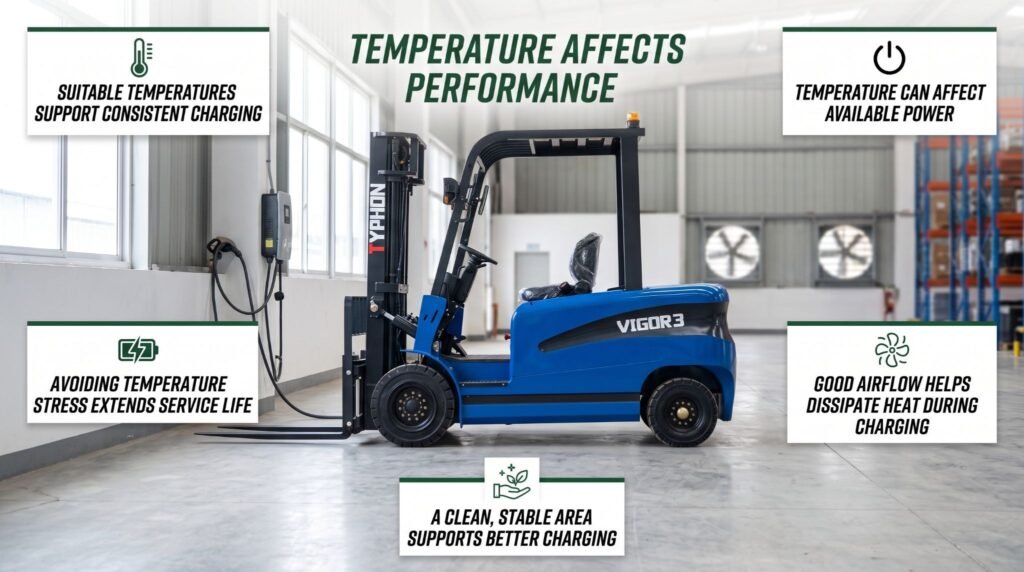
Battery temperature can affect charging efficiency, available power, and overall battery service life. Operating or charging a battery outside its suitable temperature range can increase stress and reduce consistent performance over time.
The charging area is one of the easiest places to manage these conditions. A clean, well-ventilated space helps dissipate heat and provides a more stable environment for charging, especially in busy operations where batteries are used and recharged frequently.
- Charging Efficiency: Suitable temperatures help the battery charge more consistently.
- Available Power: Temperature conditions can affect the power available during operation.
- Battery Service Life: Avoiding excessive temperature stress can support longer battery life.
- Ventilation: Good airflow helps dissipate heat during charging.
- Charging Environment: A clean, stable, and well-ventilated area helps maintain suitable charging conditions.
Key takeaway: Temperature affects charging efficiency, power, and battery life, so provide a suitable, well-ventilated charging environment to keep operating conditions stable.
Shift Patterns Change Battery Demand
Not every forklift places the same demand on its battery, and understanding your usage is key to planning maintenance well. A forklift that moves the occasional pallet draws far less energy than one running continuously across multiple shifts. Frequent lifting, long travel distances, and extended operating periods all consume more power, which changes how often the battery charges and how hard it works between charges.
Knowing that pattern lets maintenance teams plan intelligently. Charging schedules, inspection intervals, and battery rotation, where applicable, can all be matched to the actual workload rather than a generic assumption. A single-shift operation may charge overnight and run without interruption, while a demanding multi-shift operation may need battery rotation and carefully timed charging to keep forklifts moving. Reading the demand correctly is what keeps the power system ready without either overworking a battery or letting one sit underused.
Key takeaway: Usage intensity changes battery demand, so understand whether a forklift runs occasionally or across multiple shifts and plan charging, inspection, and rotation accordingly.
Routine Inspections Reduce Downtime
Regular inspections are what turn battery maintenance from reactive to proactive, catching problems before they interrupt warehouse operations. A quick, consistent check can reveal trouble while it’s still minor, which is always cheaper and less disruptive than a failure mid-shift. Make inspection a standing habit, and you give yourself the warning you need to act on your own terms.
Know what to look for. A sound inspection watches for several telltale signs:
- Damaged or fraying cables that can compromise the connection.
- Corrosion around terminals and connectors.
- Unusual odors that may signal a developing problem.
- Leaks from the battery.
- Swelling or any other visible change in the battery’s condition.
Any serious issue you find should be handled according to the manufacturer’s service procedures rather than improvised. Addressing problems the right way keeps a small concern from becoming a costly failure, and consistent inspection keeps the whole fleet dependable.
Key takeaway: Routine inspections catch damaged cables, corrosion, odors, leaks, and swelling early, and handling serious issues per manufacturer procedures reduces unexpected downtime.
Conclusion
Forklift battery life depends on battery chemistry, charging practices, operating conditions, and maintenance because each factor affects available energy, electrical efficiency, and long-term battery condition. Operators should identify the battery type and follow the manufacturer’s charging and service requirements, including the correct charger and charging cycle. Flooded lead-acid batteries require electrolyte checks and watering according to the specified procedure and timing, while terminals, cables, and connectors should be kept clean and inspected for corrosion, looseness, or damage. Charging areas should provide suitable ventilation and temperature control because excessive heat can accelerate battery degradation and affect charging performance. Maintenance schedules should also reflect actual forklift usage, including operating hours, load intensity, shift patterns, charging frequency, and fleet rotation. Regular inspections for damaged cables, corrosion, leaks, unusual odors, swelling, or other abnormal conditions can identify developing problems before they cause downtime. Matching battery care to the forklift’s duty cycle and maintaining consistent charging and inspection practices supports reliable warehouse operation and helps extend battery service life.
Frequently Asked Questions
How long does a warehouse forklift battery last?
Battery life depends on the battery type, usage intensity, charging practices, operating conditions, and maintenance. A properly charged and maintained battery generally lasts longer than one that is neglected. Heavy multi-shift use can also shorten service life compared with occasional operation. Check the manufacturer’s specifications for the expected lifespan of your specific battery and follow its charging and maintenance requirements.
How often should a forklift battery be inspected?
Perform basic visual checks regularly, often daily, for corrosion, leaks, damaged cables, swelling, or unusual odors. More detailed maintenance, such as checking electrolyte levels on flooded lead-acid batteries and cleaning terminals, should follow the manufacturer’s schedule. Inspection frequency should match the battery type and forklift workload.
Do all forklift batteries require watering?
No. Watering is generally required for flooded lead-acid batteries to maintain proper electrolyte levels. Sealed and many lithium-ion batteries do not require watering and have different maintenance needs. Identify the battery type and follow its manufacturer’s instructions to avoid improper servicing.
Can improper charging reduce forklift battery life?
Yes. Using the wrong charger, interrupting charging too often, overcharging, or returning the forklift to service before charging is complete can increase battery stress and reduce capacity over time. Use the correct charger and follow the recommended charging cycle for the battery type and operating schedule to support both runtime and service life.
