How Retractable Tracks Save Time and Money on Tight Jobsites
Why Are Retractable Tracks Useful for Mini Excavator Jobs
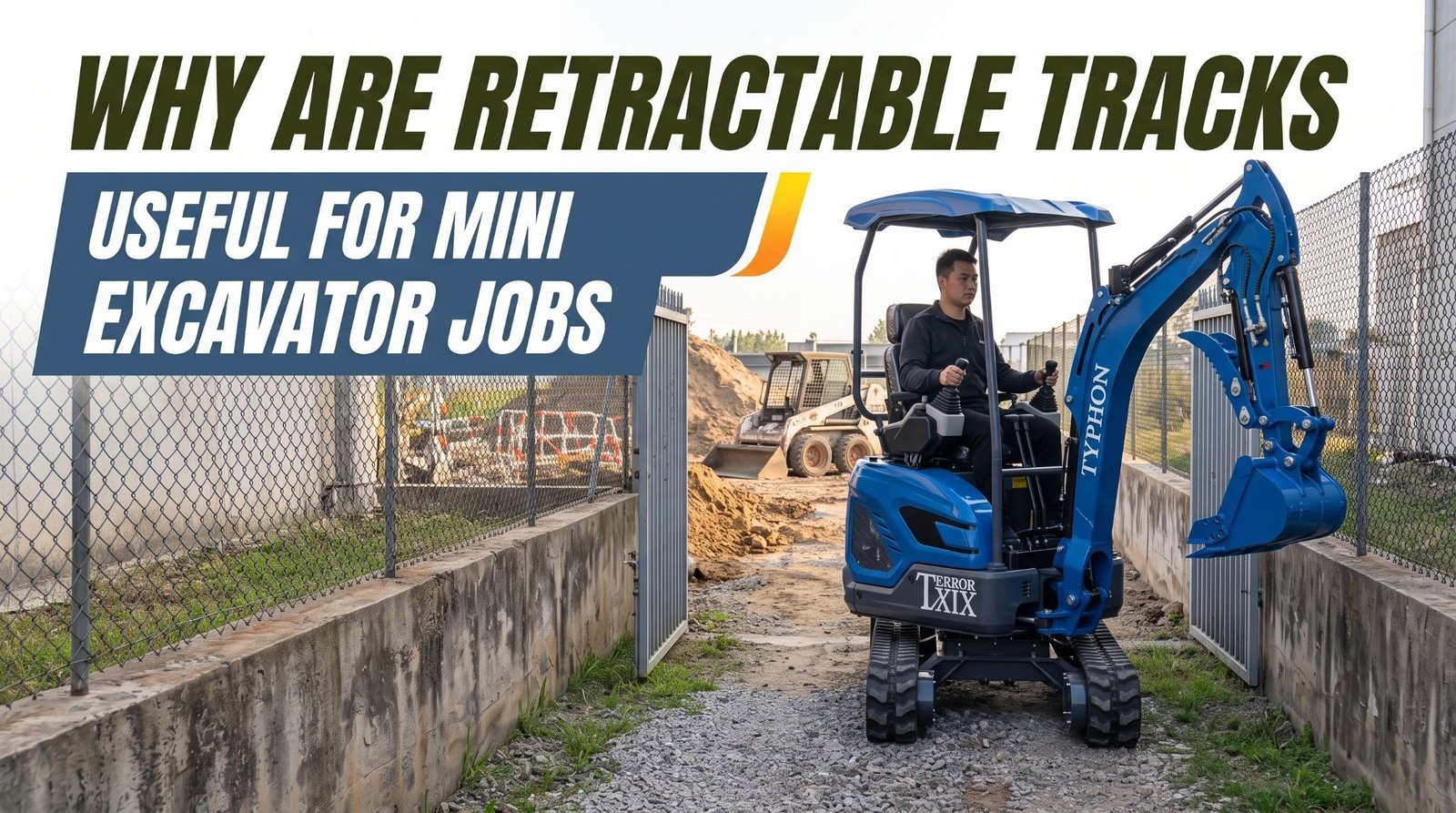
A contractor pulls up to a job with a garden gate barely wider than a wheelbarrow, and behind it waits a drainage trench that has to be dug before the day is out. The homeowner would rather not tear down a fence, and hauling in a smaller machine means a second trip, more cost, and lost hours. Standing at that gate, the width of the excavator is suddenly the only spec that matters. This is where retractable tracks quietly change the outcome. They let a machine narrow itself to slip through the gap, then spread back out once inside to dig with a firm, planted stance. It is a simple idea with a big payoff, and for anyone who works where space runs short, it can be the feature that turns an impossible site into a routine one.
Retractable tracks tend to fly under the radar when buyers compare machines, overshadowed by dig depth, engine size, and lifting numbers. Yet in the cramped residential and urban jobs that mini excavators handle every day, the ability to change track width on demand shapes how many sites a machine can even reach. This post breaks down what retractable tracks are and how they work, why track width carries so much weight on confined jobsites, how the system balances access against stability, how it stacks up against fixed-width tracks, what habits help operators use it well, and how to read track specifications when choosing a machine.
What Retractable Tracks Are and How They Work
Retractable tracks, sometimes called variable-width or expandable undercarriages, are exactly what the name suggests: a track system that can widen or narrow to suit the job. Instead of a fixed steel frame holding the two tracks a set distance apart, a retractable undercarriage mounts each track on an arm or slide that moves inward and outward. The operator adjusts the width from the controls, usually through the machine’s hydraulic system, and the tracks glide to the position the work calls for. Pull them in for a slim profile that fits through gates and doorways, push them out for a broad, stable base once there is room to spread.
The mechanism itself is straightforward in principle. Hydraulic cylinders drive the track frames along their guides, extending or retracting them by a fixed range, often a foot or so of total travel between the narrowest and widest settings. On a typical mini excavator, the tracks might retract to somewhere around 49 inches and extend to roughly 59 inches, though the exact figures vary by model. The change takes only a moment, and it can be done on the spot without tools or manual labor. That convenience is central to the appeal, because a machine that adjusts its own width in seconds gives the operator a genuine choice at every stage of a job rather than locking them into one footprint from arrival to departure.
Key takeaway: Retractable tracks are a hydraulically adjustable undercarriage that lets the operator narrow the machine to fit through tight openings and widen it for a stable base, all from the controls in seconds.
How Retractable Tracks Improve Access Without Sacrificing Stability
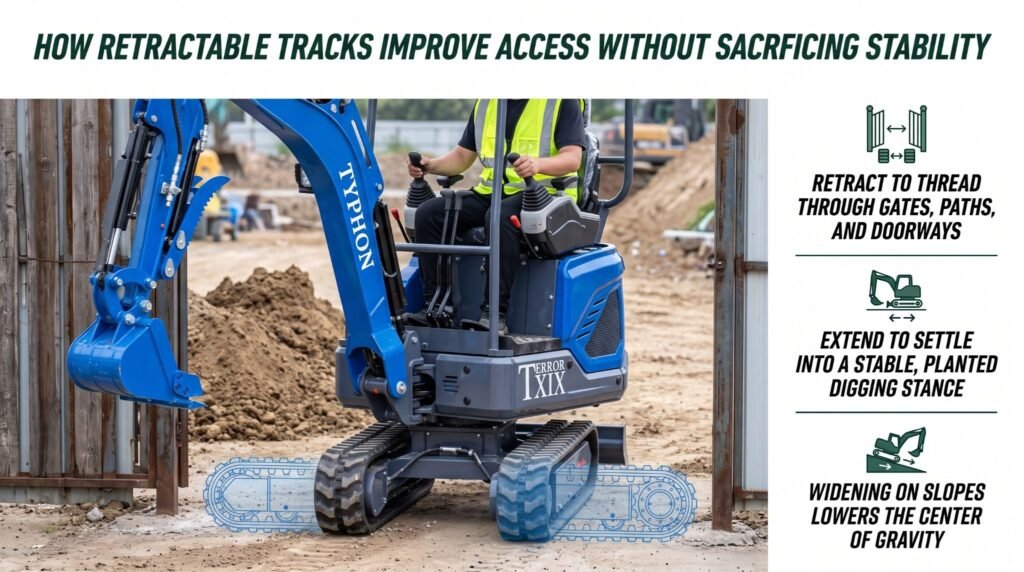
The real strength of a retractable undercarriage is that it refuses to force a choice between getting in and working well. The operator arrives, retracts the tracks to their narrowest setting, and threads the machine through the gate, along the path, or through the doorway that would stop a wider excavator cold. Once inside and clear of the pinch point, a quick extension of the tracks spreads the base back out, and the machine settles into a stable, planted stance ready for serious digging. Access and stability stop competing and instead take turns, each available exactly when the job needs it.
That flexibility pays off throughout a shift, not just at the entrance. A trench might run alongside a wall in a spot where the machine has to stay narrow to fit, then open into a wider area where extending the tracks steadies the lift. On sloped or uneven ground, widening the base lowers the machine’s center of gravity relative to its footprint and improves its footing, which matters when the boom swings a full bucket to the side. The operator reads the space and the task, then sets the width to match, retracting to squeeze past an obstacle and extending to dig with authority. This ability to adapt in real time is what lets one compact machine handle a range of conditions that would otherwise demand either a smaller unit for access or a larger one for stability.
Key takeaway: Retractable tracks let access and stability take turns rather than compete, narrowing to reach the work and widening to dig steadily, so a single machine adapts to tight approaches and demanding digging alike.
How Retractable Tracks Compare to Fixed-Width Tracks
Fixed-width tracks hold the two track frames a set distance apart, and that simplicity brings its own advantages. A fixed undercarriage has fewer moving parts, which means less to maintain and one less system that can wear or fail over the machine’s life. Machines built this way are often lighter and less expensive, and for work on open sites where access is never in question, a fixed base delivers all the stability needed without any added complexity. If your jobs rarely involve tight gates or narrow paths, the straightforwardness of a fixed undercarriage is a genuine benefit rather than a limitation.
The trade-off appears the moment access tightens. A fixed-width machine is committed to a single footprint, so it must be narrow enough to reach confined sites, which leaves it with a smaller base for digging, or wide enough to dig steadily, which shuts it out of tight jobs entirely. Retractable tracks sidestep that compromise by delivering both profiles in one machine, at the cost of a somewhat more complex undercarriage, a modest increase in maintenance, and usually a higher purchase price. The honest comparison comes down to the work you do. For contractors whose days are spent squeezing into residential and urban spaces, the versatility of retractable tracks earns its keep quickly. For those working mostly open ground, a fixed undercarriage offers dependable stability with less to manage and a lower cost.
Key takeaway: Fixed-width tracks are simpler, lighter, and cheaper but locked to one footprint, while retractable tracks add cost and complexity in exchange for the versatility of both a narrow access profile and a wide digging base.
Practical Tips for Using Retractable Tracks Effectively
Getting the most from a retractable undercarriage starts with treating width as an active choice at every stage of a job, not a setting you fix on arrival and forget. Retract fully for the approach so you clear the tightest pinch point with room to spare, then extend as soon as space opens up so you are not digging on an unnecessarily narrow base. Many operators lose stability simply because they left the tracks retracted after entering, out of habit rather than need. Building a routine of checking and adjusting width as conditions change keeps the machine working at its best throughout the shift.
Beyond that basic habit, a few practices sharpen the results. Before digging or lifting to the side, extend the tracks to the widest setting the space allows, since that is where the machine is most stable under load. When retracting to squeeze past an obstacle, slow down and watch both tracks clear the pinch point, because a rushed maneuver in a tight spot is where damage happens. On soft or uneven ground, a wider stance spreads the machine’s weight and improves footing, so favor extension wherever the surface is questionable. And always adjust width on firm, level ground when you can, since moving the tracks in and out is smoothest and safest when the machine is settled rather than perched on a slope. Small, deliberate adjustments like these turn a useful feature into a real productivity gain.
Key takeaway: Use track width as an active choice throughout the job, retracting only to clear tight spots and extending for digging and lifting, while adjusting on firm ground and slowing down through pinch points.
How to Evaluate Track Specs When Choosing a Machine
When tight-access work is central to what you do, the undercarriage specifications deserve close attention rather than a quick glance. Start with the two width figures that define a retractable system: the fully retracted width and the fully extended width. The retracted number tells you the narrowest opening the machine can clear, so compare it honestly against the tightest gates and paths on your typical sites. The extended number tells you how broad and stable the base becomes for digging, and a generous spread between the two gives you the widest range of usefulness. Both figures matter, and reading them together shows you what the machine can genuinely handle.
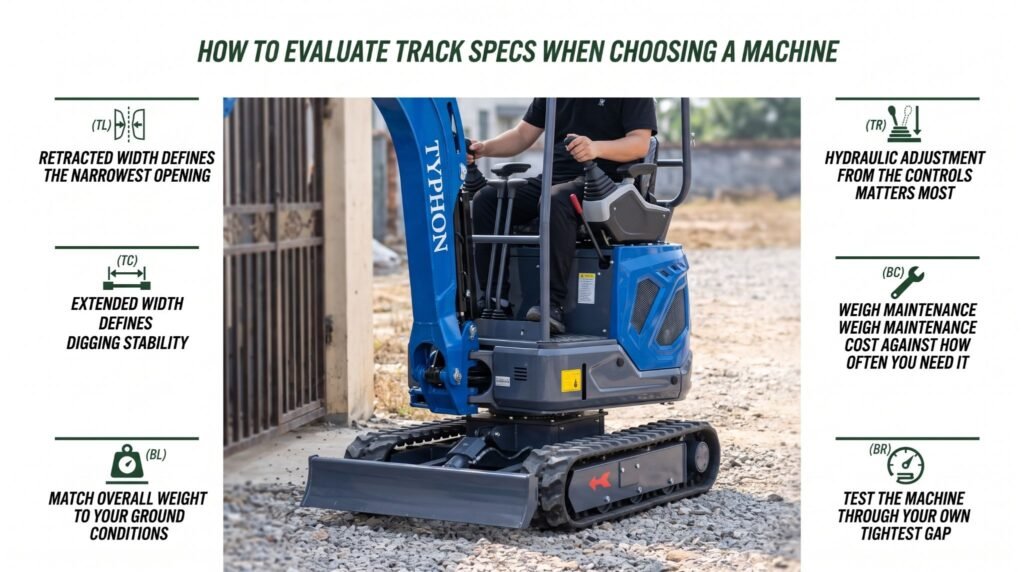
From there, look at how the undercarriage fits the rest of the machine and your real conditions. Consider the machine’s overall weight and how it moves on the ground you work, since a stable extended base counts for little if the excavator is poorly matched to your soil or slopes. Check that the width adjustment is hydraulic and operated from the controls, because a system that adjusts quickly and easily is one you will actually use, while a cumbersome one tends to sit in a single position. Factor in the added maintenance and cost of a retractable undercarriage against how often you truly need it, and weigh it against a fixed-width machine if your access is rarely a problem. Wherever possible, run a candidate machine on ground like your own, retract it through a gap the size of your tightest site, and extend it to dig, since feeling how smoothly it adjusts and how steadily it works tells you more than any brochure figure.
Key takeaway: Evaluate the retracted and extended widths together against your tightest access points and your digging needs, confirm the adjustment is quick and hydraulic, and weigh the added cost against how often your work truly demands it.
Conclusion
Retractable tracks solve one of the most stubborn problems in confined excavation: the machine that fits through the gate is rarely the one that digs steadily once inside. By letting the operator narrow the undercarriage for access and widen it for stability, a variable-width system delivers both without compromise, turning a single compact excavator into a machine that adapts to the approach and the work in equal measure. On the residential and urban jobs where inches decide everything, that adaptability is often what separates the excavators that can take a job from the ones that get left at the curb.
Frequently Asked Questions
How much can retractable tracks actually change a mini excavator’s width?
Most retractable undercarriages provide about 1 foot of total width adjustment. A common range is roughly 49 inches retracted to 59 inches extended. The narrow setting helps clear gates and doorways, while the wider position provides a more stable base for digging. Check both dimensions when comparing machines.
Does digging with the tracks retracted damage the machine or make it unsafe?
Not automatically, but retracted tracks create a narrower and less stable base. This can increase tipping risk when reaching, swinging a loaded bucket, or working on soft or sloped ground. Use the narrow setting mainly for access, then extend the tracks before heavy digging whenever space allows.
Are retractable tracks worth the extra cost over fixed-width tracks?
It depends on how often you work in tight spaces. Retractable tracks cost more and add some maintenance, but they allow one excavator to pass through narrow openings and then widen for greater stability. For open jobsites, fixed-width tracks may provide simpler, lower-cost operation. Consider how often restricted access affects your work.
