Skid Steer Attachments Compatibility and Hydraulic Flow
Skid Steer Attachments: What Changes What the Machine Can Do
A landscaping contractor buys a skid steer with a single bucket and figures it’ll cover most of his work. Two weeks in, a job calls for digging fence-post holes, so he rents an auger. The next site needs stumps cleared, then a client wants a rough lot mulched, and suddenly he’s renting a different tool every few days. Halfway through the season he realizes the machine sitting in his yard could have done all of it with the right attachments bolted to the front, and the rental receipts stacking up on his desk prove how much that lesson cost. That slow realization is exactly why understanding attachments matters before you assume a skid steer is just a bucket on wheels.
A skid steer is only as versatile as the tools you hang on it, and the attachment out front decides what job the machine can actually do. Swap the bucket for an auger and it drills holes; fit a breaker and it demolishes concrete; mount a set of forks and it becomes a material handler. This guide walks through why attachments matter so much, the main categories worth knowing, how each one reshapes the machine’s capability, how to match a tool to the job, the compatibility and hydraulic flow details that trip people up, and whether owning attachments beats renting them. Here’s what to know before you pick a tool for the front.
Why the Tool Up Front Defines the Machine
Versatility is the whole reason skid steers dominate job sites, and that versatility lives entirely in the attachment. The machine itself supplies the power, the hydraulics, and the mobility, but the tool bolted to the front is what turns that raw capability into digging, lifting, cutting, or breaking. One machine with a rack of attachments does the work of several single-purpose machines.
Cost savings follow directly from that flexibility. Rather than buying a separate excavator, auger truck, and forklift, a contractor invests in one skid steer and swaps tools as the work changes, which spreads a single machine’s price across far more jobs. Attachments generally cost a fraction of a dedicated machine, so building a small collection stretches your equipment budget hard.
Key point: Think of the skid steer as a power source and the attachments as its many hands. The machine’s value multiplies with every capable tool you can mount, so the attachments you choose shape what your operation can take on.
The Main Categories Worth Knowing
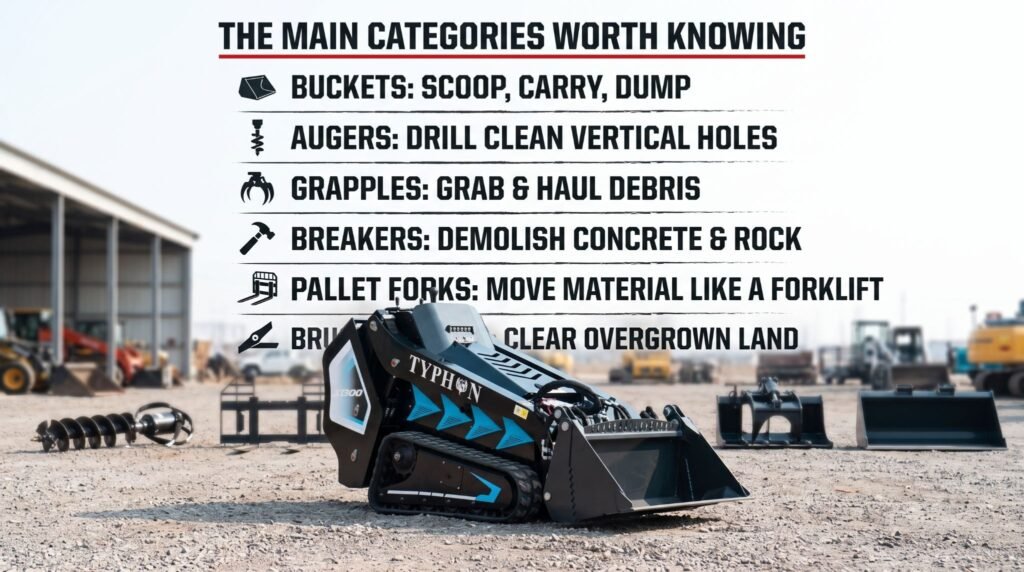
Different jobs call for different tools, so knowing the common attachment categories keeps you from forcing the wrong one onto the work. Each design solves a particular problem, and matching the tool to the task saves both time and rework. Here’s a look at the attachments you’ll reach for most:
- Buckets: The default tool, buckets scoop, carry, and dump dirt, gravel, snow, and debris. Variations like low-profile, rock, and multi-purpose buckets handle everything from light material to grading and dozing.
- Augers: Fitted with a rotating bit, augers drill clean vertical holes for fence posts, footings, deck piers, and tree planting, swapping bit sizes to match the diameter you need.
- Grapples: Built with a clamping arm over the bucket or tines, grapples grab and haul brush, logs, rock, scrap, and demolition debris that a plain bucket can’t hold.
- Breakers (hammers): These hydraulic hammers pound through concrete, asphalt, and rock, turning the skid steer into a compact demolition machine for slabs, foundations, and hardscape removal.
- Pallet forks: Two forks turn the machine into a rough-terrain forklift, moving pallets, block, lumber, and bagged material around a site where a warehouse forklift can’t go.
- Brush cutters and mulchers: Spinning heavy blades or drums, these clear overgrown brush, saplings, and small trees, reducing thick growth to mulch on land-clearing and right-of-way work.
Specialty tools extend the list even further. Trenchers, snow blowers, sweepers, tillers, cold planers, and stump grinders all mount to the same machine, so the attachment world reaches well beyond the everyday handful. Knowing which categories fit your typical work points you toward the tools worth owning first.
How Each Attachment Reshapes Capability
Buckets and forks handle the bread-and-butter material work, and they’re where most operators start. A bucket moves loose material and grades a surface, while forks lift and carry palletized loads, so between the two the machine covers hauling, loading, and material handling on nearly every site. Swapping from one to the other takes minutes and shifts the machine from a loader to a lift truck.
Digging and drilling tools open up ground work the bucket can’t touch. An auger bores precise holes for posts and piers, a trencher cuts narrow channels for utility lines and irrigation, and both turn the skid steer into an earthmoving specialist for tasks that would otherwise demand hand digging or a separate machine. Fitting the right bit or chain matches the tool to the exact depth and width the job needs.
Demolition and clearing attachments push the machine into the heaviest work. A breaker shatters concrete and rock, a grapple hauls away the resulting debris, and a mulcher or brush cutter clears overgrown land down to workable ground. Running these tools transforms a compact loader into a demolition and land-clearing machine, though each one demands that the skid steer supply enough hydraulic power to drive it, which brings flow into the picture.
Matching the Tool to the Job at Hand
Job type points you toward the right attachment faster than anything else, so picture the work before you choose. Moving dirt and gravel calls for a bucket, setting fence posts calls for an auger, clearing brush calls for a cutter, and breaking a slab calls for a hammer. Naming the task first narrows the field to the tool built for it.
Material and conditions refine the choice from there. Rocky ground rewards a rock bucket or a breaker, soft brushy land suits a mulcher, and finished surfaces you can’t damage favor lighter tools handled with care. Reading what you’re actually working with keeps you from bringing a tool that’s too aggressive or not aggressive enough for the material in front of you.
Consider a contractor prepping a rural lot for a new home. He clears overgrown brush with a mulcher, digs footing holes with an auger, hauls cleared debris with a grapple, then grades the pad and backfills with a bucket, all from one machine by swapping tools through the day. What this means: map your real sequence of tasks against the available attachments, and a single skid steer covers a whole job that would otherwise scatter across several machines.
Compatibility and Hydraulic Flow You Can’t Ignore
Mounting fit comes first, since an attachment has to physically connect to your machine. Most modern skid steers use a universal quick-attach plate, which lets a wide range of tools click on in seconds, but older or off-brand machines sometimes use a different pattern that won’t match. Confirm the attachment’s mounting plate suits your machine before you buy or rent it.
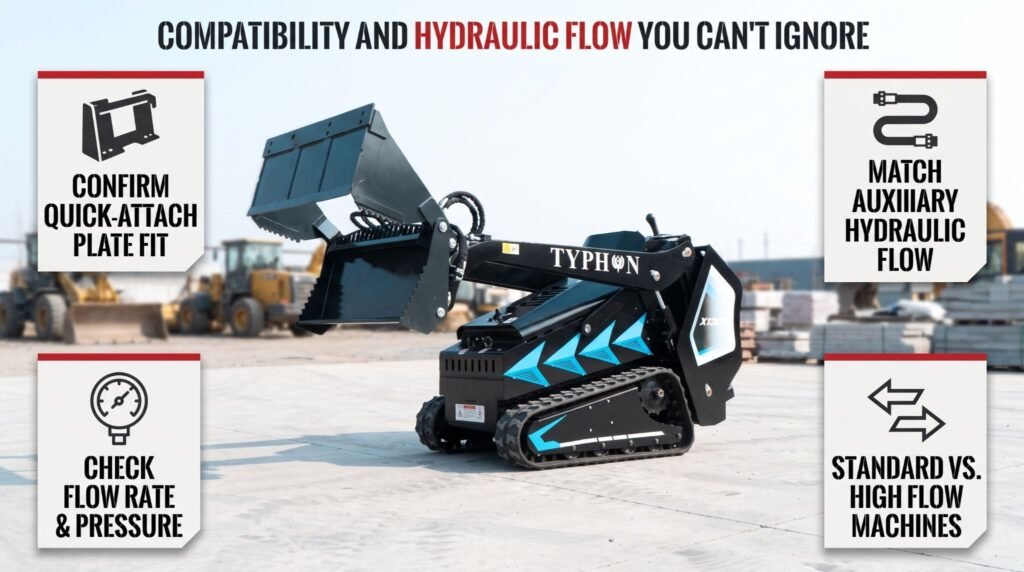
Hydraulic flow is where operators get caught most often, and it decides whether a powered tool actually works. Attachments with moving parts, like augers, breakers, mulchers, and trenchers, run off the machine’s auxiliary hydraulics, and each tool needs a certain flow rate and pressure to perform. A mulcher rated for high-flow hydraulics starves and stalls on a machine that only supplies standard flow, so matching the tool’s flow requirement to your machine’s output is essential.
Standard versus high flow is the split worth understanding. Standard-flow skid steers handle buckets, forks, augers, and lighter powered tools, while high-flow machines drive the demanding attachments like large mulchers, cold planers, and heavy breakers. Key point: check both the mounting plate and the hydraulic flow rating against your machine before committing to any powered attachment, since a tool your skid steer can’t feed is a tool that won’t do the job.
Weighing Ownership Against Renting Your Tools
Cost is the question every contractor weighs, and the buy-versus-rent call comes down to how often you’ll use a given tool. Attachments you reach for on nearly every job, like a bucket, forks, and maybe an auger, usually earn their price fast through steady use, so owning them makes plain sense. Tools that sit idle most of the season rarely justify the purchase.
Frequent-use tools reward ownership. When a job calls for the same attachment week after week, owning it means the tool stands ready on your schedule, sized and matched to your machine, without a rental fee or a trip to the yard every time. Those savings and that convenience compound across a busy stretch of work.
Occasional or specialty tools often favor renting. A stump grinder, cold planer, or heavy mulcher used a handful of times a year sidesteps ownership costs by renting for those windows, which keeps expensive, seldom-used tools out of your yard. What this means: build a core set of attachments you own for daily work, rent the specialty tools you need rarely, and weigh each tool’s real usage against its price to keep the spend lean.
Conclusion
A skid steer’s capability lives in the attachment out front, and swapping tools turns one machine into a loader, a lift truck, a drill, a demolition hammer, and a land-clearing cutter as the work demands. Start by knowing the main categories, buckets, forks, augers, grapples, breakers, and cutters, then match the tool to your job type, material, and site conditions before you mount it. Confirm both the mounting plate and the hydraulic flow rating suit your machine, since a powered tool your skid steer can’t feed simply won’t perform. Own the attachments you use constantly and rent the specialty ones you need rarely, weighing each tool’s real usage against its price. Choose your attachments well, and a single machine covers work that would otherwise take a whole fleet. When you’re ready to put a dependable skid steer and the right attachments to work, reach out to a trusted equipment specialist who can pair a reliable machine with the results your projects depend on.
Frequently Asked Questions
What attachments can a skid steer use?
A skid steer runs a wide range of tools, including buckets, pallet forks, augers, grapples, hydraulic breakers, brush cutters, and mulchers, plus specialty attachments like trenchers, snow blowers, sweepers, and stump grinders. Each tool changes what the machine does, so one skid steer can dig, lift, haul, break, and clear simply by swapping the attachment on the front.
Do skid steer attachments work on any machine?
Not always. Two things decide compatibility: the mounting plate and the hydraulic flow. Most modern skid steers use a universal quick-attach plate, but older or off-brand machines may differ. Powered tools also need a matching hydraulic flow rate and pressure, so a high-flow attachment won’t perform on a standard-flow machine. Check both before you buy or rent.
Should I buy or rent skid steer attachments?
It depends on how often you’ll use each tool. Attachments you reach for on nearly every job, like a bucket, forks, or an auger, usually earn their price quickly, so owning them makes sense. Specialty tools you need only a few times a year, such as a mulcher or stump grinder, often cost less to rent for those windows than to own and store.
Skid steer attachments are what make these compact machines so versatile across construction, landscaping, agriculture, demolition, and material-handling jobs. Choosing the right attachment allows one skid steer to perform work that might otherwise require several specialized machines.
Main Types of Skid Steer Attachments
Different skid steer attachments are designed for different jobs. Buckets handle material loading and grading, augers drill holes, grapples move logs and debris, breakers demolish concrete, pallet forks handle loads, and brush cutters clear vegetation.
How Skid Steer Attachments Reshape Machine Capability
The right skid steer attachments can transform the same machine from a loader into a drilling, lifting, trenching, demolition, or land-clearing machine. This flexibility allows operators to adapt quickly as job-site requirements change.
Matching Skid Steer Attachments to the Job
Choosing skid steer attachments should start with the work you need to perform. Consider the material, terrain, required operating capacity, attachment size, and how frequently the tool will be used.
7 Best Skid Steer Attachments for Powerful Jobsite Performance
Before purchasing skid steer attachments, check both the mounting system and hydraulic requirements. Powered attachments such as augers, breakers, trenchers, and mulchers need sufficient auxiliary hydraulic flow and pressure to operate correctly.
Buying vs. Renting Skid Steer Attachments
Frequently used skid steer attachments, such as buckets, pallet forks, and augers, can make sense to own. Specialized attachments used only occasionally may be more economical to rent.
Conclusion
Choosing the right skid steer attachments can dramatically expand what one machine can accomplish. By matching each attachment to the job and checking mounting and hydraulic compatibility, operators can get more productivity and versatility from their skid steer.
