Do I Need a License to Operate a Road Roller?
Why Road Roller Licensing Requirements Vary
Do I Need a License to Operate a Road Roller?
Do I Need a License to Operate a Road Roller? Whether you need a license to operate a road roller depends on your location, the type of machine, whether it will be used on public roads, and the training requirements set by your employer or job site.
A new hire climbs into the seat of a road roller for the first time, ready to compact a fresh gravel base on a private commercial lot. The foreman assumes the crew is covered, the operator assumes someone checked the rules, and the machine rolls out with nobody actually certain whether a license, a certification, or any formal training was required. The job went fine that day. But a surprise inspection the following week, or worse, an incident, would have exposed a gap that could stall the project, trigger fines, and put the whole crew’s compliance record in question.
That uncertainty is common, and it costs contractors more than they realize. The rules around operating a road roller aren’t as simple as a single yes-or-no answer. They shift depending on where you work, what kind of machine you run, whether the site touches a public road, and who owns the property you’re compacting. Guess wrong in either direction and you either waste time chasing paperwork you don’t need or expose your operation to real liability you didn’t see coming.
The answer depends on four things: the jurisdiction you operate in, the type and size of the machine, whether the work happens on a public road or a closed site, and the training standards your employer or client enforces. Get clear on those, and the licensing picture snaps into focus. Here’s how the requirements actually break down, what training typically applies, why job-site rules often go beyond the law, and how to confirm exactly what your situation demands.
Why Licensing Requirements Vary So Widely
Behind the question of whether you need a license sits a messier truth: there’s no single universal rule. Requirements change from one region to the next and from one machine class to another, which is exactly why so many operators get conflicting answers. Sorting out the variables is the first step toward a clear answer.
Jurisdiction Shapes the Baseline
Where you work sets the foundation for what’s required. Different countries, states, provinces, and even municipalities write their own rules for operating heavy equipment, so a requirement that’s strict in one place may not exist a few hundred miles away. What counts as a legal must-have in one jurisdiction can be merely recommended in another.
That variation is why you can’t rely on advice from a contractor in a different region. The safest starting point is treating local law as the authority that overrides general assumptions. Checking your area’s specific road roller operator requirements before a job is the only way to know the baseline you’re actually working from.
Machine Type and Size Change the Rules
Not every road roller falls under the same category. A small walk-behind or ride-on compactor is often treated very differently from a large, self-propelled road roller, and the line between “light equipment” and “heavy machinery” can determine whether formal credentials apply at all.
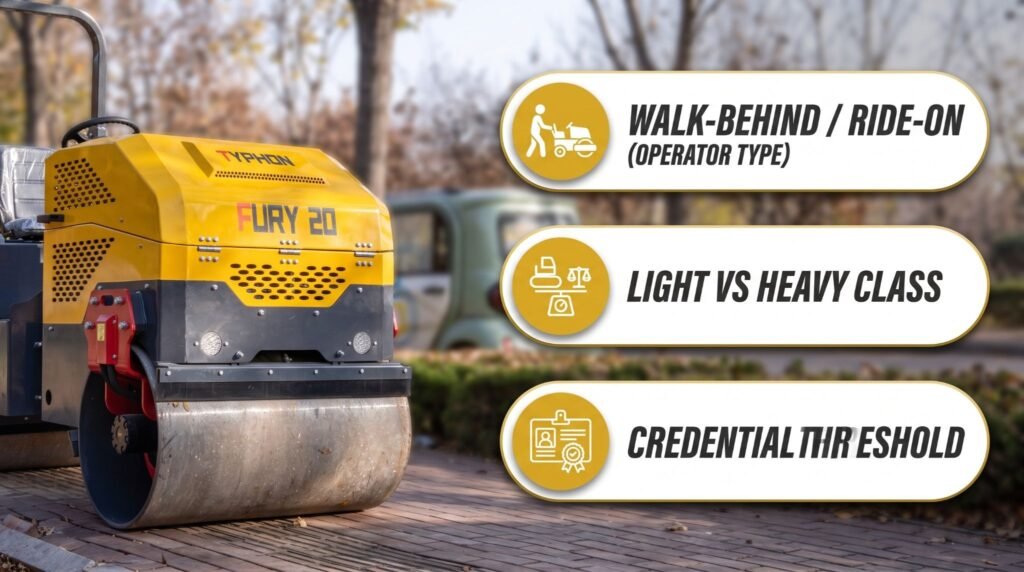
Weight, drum configuration, and whether the machine is self-propelled all factor into how it’s classified. Heavier machines that move under their own power tend to carry stricter requirements, since the risk they pose is greater. When you weigh compaction equipment licensing rules, the machine’s category matters just as much as your location.
Road Use Versus Off-Road Operation
Whether the machine travels on or crosses a public road is often the pivot point. A roller working entirely within a closed private site is frequently governed by workplace and equipment rules, while one that must drive on or along a public roadway can trigger separate vehicle-operation requirements.
That distinction catches operators off guard. A machine that needs no special road license inside a fenced yard may require one the moment it moves onto a public street to reach the next section of work.
Takeaway: licensing requirements vary by your jurisdiction, the machine’s type and size, and whether the work touches a public road, so no single answer fits every operator.
Do I Need a License to Operate a Road Roller
What Certifications and Training Typically Apply
Once you know that requirements vary, the next question is what those requirements usually look like in practice. Even where a formal government license isn’t demanded, some form of competency proof almost always is. Knowing the common categories helps you anticipate what you’ll likely need.
Formal Licenses Versus Competency Certifications
There’s an important difference between a government-issued license and a competency certification. A license is a legal permit granted by an authority, often tied to road use or specific heavy-equipment classes. A certification, by contrast, proves you’ve completed recognized training and can operate the machine safely, and it’s frequently what employers and clients actually ask to see.
In many settings, the practical requirement isn’t a driver’s-style license at all but documented proof of proper training. That’s why plenty of operators work legally without a formal license yet still can’t step onto a site without a valid certification card. Both matter, and they serve different purposes.
Recognized Operator Training Programs
Structured training is the backbone of most compaction work. Reputable programs teach machine controls, compaction technique, stability and tip-over prevention, ground assessment, and safe travel around a site. Completing one gives an operator both the skills and the paper trail that sites increasingly demand.
The value goes beyond compliance. A well-run certified heavy equipment training course reduces accidents, protects the machine from misuse, and makes an operator genuinely more productive. Even where the law is silent, that training is what separates a safe, employable operator from a liability.
Employer Duty to Verify Competence
In most workplace-safety frameworks, the responsibility doesn’t rest on the operator alone. Employers are generally required to ensure that anyone operating heavy equipment is trained and competent to do so, and to keep records proving it. That duty exists whether or not a formal license is involved.
For contractors, this means training isn’t optional even when a government license isn’t required. An employer who lets an untrained worker run a roller carries real liability if something goes wrong.
Takeaway: the requirement is usually competency-based, so expect to need recognized operator training and documentation, with formal licenses applying mainly to specific machine classes or public-road use.
How Job Site Rules Often Go Beyond the Law
Legal minimums are only part of the story. Many operators discover that the site they’re working on demands more than the law technically requires, and that gap trips up crews who assume compliance stops at the statute. The rules set by employers, clients, and site owners frequently raise the bar.
Client and Site-Owner Requirements
Property owners and general contractors routinely set their own operating standards. A large commercial site, an industrial facility, or a public works project may require every equipment operator to hold a specific certification, carry proof on-site, and complete a site-specific orientation, regardless of what local law demands.
These requirements exist to manage risk and insurance exposure. A site owner who lets uncertified operators run machinery risks their own liability, so they push the standard down to every contractor on the property. Meeting the legal minimum won’t get you through the gate if the client’s rules are stricter.
Insurance and Contractual Conditions
Insurance often quietly sets the real bar. Many policies covering equipment operation, job-site liability, and workers’ coverage require that operators be certified and that training records be maintained. Fail to meet those conditions and a claim can be denied, turning a covered incident into an out-of-pocket disaster.
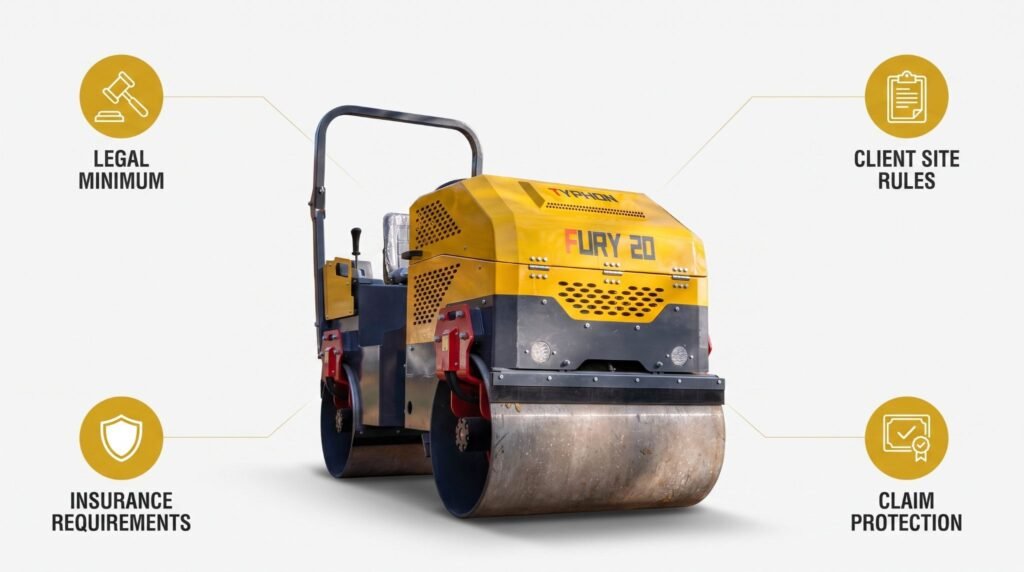
Contracts reinforce this. Bid documents and service agreements frequently spell out that all operators must be properly trained and credentialed, making certification a condition of getting and keeping the work. Understanding these heavy equipment operation standards is often what wins and protects a contract, not just what keeps you legal.
Internal Safety Programs
Well-run operations set their own standards too. A company committed to safety typically requires all operators to complete internal training and demonstrate competence before touching a machine, layering its own program on top of any external requirement. This protects workers, equipment, and the company’s reputation.
That internal discipline pays off in fewer incidents and lower long-term costs. It also positions a contractor to meet client and insurer demands without scrambling, since the training is already in place.
Takeaway: job-site, client, insurance, and internal requirements frequently exceed the legal minimum, so being legal isn’t enough if the site you’re working on demands more.
How to Confirm What Applies to Your Situation
With the variables clear, the final task is pinning down exactly what your specific job requires. Guessing is what gets operators and contractors into trouble, so a short, deliberate process is worth the effort every time the situation changes. Here’s how to get a definitive answer.
Ask the Right Questions First
Start by defining your exact situation before you go looking for rules. The specifics determine everything, so gather these details up front:
- Where is the work located? Identify the country, state or province, and municipality that governs the site.
- What machine will you run? Note its type, size, weight class, and whether it’s self-propelled.
- Does the roller touch a public road? Confirm whether it will drive on, along, or across any public roadway.
- Who owns or controls the site? Determine whether it’s private property, a client’s project, or a public works job with its own rules.
Check Local Rules and Site Requirements
Once you know your situation, verify the legal side with the authorities that actually govern it. Consult your regional workplace-safety and transportation authorities to confirm what licenses or certifications the law requires for your machine and setting. Treat that as the non-negotiable baseline you have to meet.
Then layer the site’s demands on top. Ask the client, general contractor, or site owner what certifications and orientations they require, and check your insurance and contract terms for any conditions on operator credentials. The strictest applicable requirement is the one you actually have to satisfy.
Get Trained and Keep Records
When in doubt, training is the safe default. Completing a recognized operator program covers you across almost every scenario, since it satisfies competency requirements whether or not a formal license applies. It’s the single step most likely to keep you compliant no matter where the work takes you.
Keep documentation current and accessible. Store certification cards, training records, and any required licenses where you can produce them on demand, and refresh them before they expire.
Takeaway: confirm your exact situation, verify both the legal baseline and the site’s requirements, then complete recognized training and keep records ready, so you’re covered whatever the job demands.
Frequently Asked Questions
Do I legally need a license to operate a road roller?
It depends on where you work and what machine you run. Some jurisdictions require a formal license or certification, especially for large, self-propelled rollers or work involving public roads, while others require only that you’re trained and competent. There’s no universal answer, so check your local workplace-safety and transportation authorities for the rules that apply to your specific machine and location before you operate.
What training do road roller operators usually need?
Most operators complete a recognized program covering machine controls, compaction technique, stability and tip-over prevention, ground assessment, and safe site travel. This training builds real skill and produces the documentation that sites and insurers increasingly require. Even where the law doesn’t mandate a license, employers generally must ensure operators are trained and competent, so completing a reputable course is the reliable way to stay covered.
How do I find out exactly what my job requires?
Do I Need a License to Operate a Road Roller?
Define your situation first: the location, the machine’s type and size, whether it touches a public road, and who controls the site. Then verify the legal baseline with your regional safety and transportation authorities, and confirm the site’s demands with the client, contractor, or owner, plus your insurance and contract terms. The strictest applicable requirement is the one you must satisfy, and recognized training is the safest default when in doubt.
Do I Need a License to Operate a Road Roller? The answer depends on your location, the type and size of road roller you operate, whether the machine enters a public road, and the training requirements established by your employer or job site. Some jurisdictions require a license or formal certification, while others require operators only to be properly trained and competent.
Many contractors ask, “Do I Need a License to Operate a Road Roller?” because the rules are not the same everywhere. Requirements can change between countries, states, provinces, municipalities, and construction sites. Understanding the applicable rules before operating the machine can help prevent fines, project delays, safety incidents, and insurance problems.
After the introduction
Before operating any compaction equipment, many people ask, “Do I Need a License to Operate a Road Roller?” Understanding the answer before starting work can help you avoid legal issues, improve job-site safety, and meet employer or client requirements.
After the section about public roads
If your project involves crossing or traveling on a public road, the answer to Do I Need a License to Operate a Road Roller may be different from operating entirely on private property. Always verify local transportation regulations before moving the machine.
After the training section
Even when the law does not require a government-issued license, Do I Need a License to Operate a Road Roller remains an important question because many employers require certified operator training and proof of competency.
Before the conclusion
The simplest way to answer Do I Need a License to Operate a Road Roller is to check your local regulations, confirm the job-site requirements, and complete recognized operator training before using the equipment.
Conclusion
Licensing rules for road rollers aren’t uniform, and the gap between what the law requires and what your job site demands can be wider than most operators expect. Your location, the machine’s class, whether it ever touches a public road, and the standards your client and insurer enforce all shape what you actually need. The surest path through that complexity is to nail down your specific situation, meet the strictest applicable requirement, complete recognized training, and keep every credential current and ready to show. Do that consistently, and compliance stops being a question you scramble to answer and becomes a standard your operation simply holds.
Whether you need a license to operate a road roller comes down to your specific circumstances rather than a single blanket rule. Requirements vary by jurisdiction, by the machine’s type and size, and by whether the work touches a public road. Even where no formal license is required, competency-based certification and documented training are usually expected, and job-site, client, and insurance rules frequently raise the bar well above the legal minimum. The operators and contractors who stay clear of trouble treat the law as the floor, confirm the site’s demands on top of it, and keep their training current.
