TYPHON VIGOR forklift space requirements
How Much Space Does a TYPHON VIGOR Forklift Need to Operate?
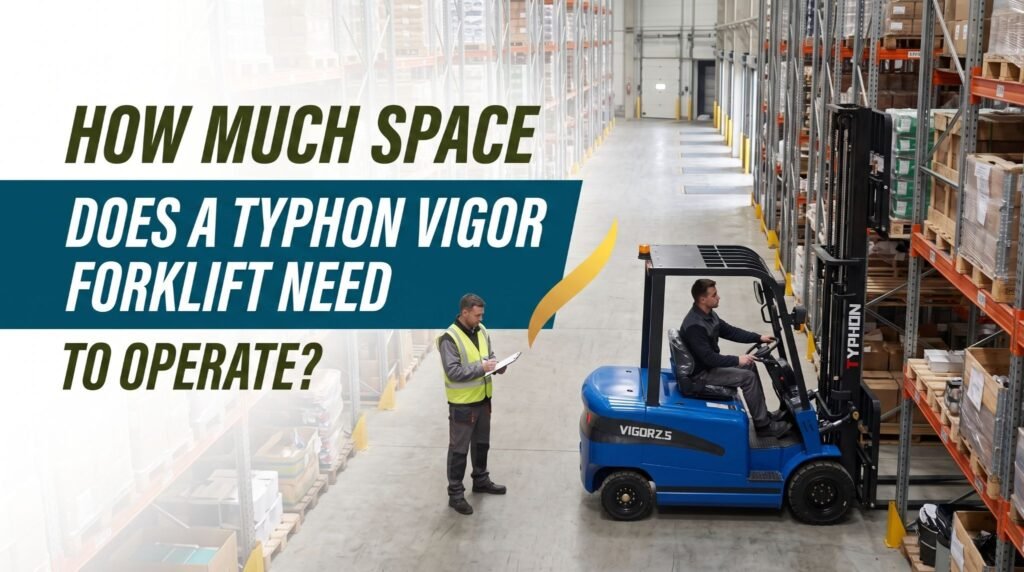
A warehouse supervisor walks the floor before a busy receiving shift, clipboard in hand, trying to figure out whether the new TYPHON VIGOR forklift will handle the tightest corners of the storage layout. The racking runs deep, the cross-aisles are narrow, and the loading dock sits at the far end of a run that turns twice before it opens up. The machine looked capable on the spec sheet, but now the supervisor is asking the real question every facility manager faces before committing to a new lift. Will it fit the aisles, turn at the rack ends, reach the top shelves, and move pallets through the dock without clipping a post or stalling the operation? Guessing wrong means damaged racking, bottlenecked workflows, and a forklift that spends more time maneuvering than working.
Knowing how much space a TYPHON VIGOR forklift needs to operate is the difference between a smooth facility and a frustrated one, and the answer comes down to a handful of measurements you can confirm before the machine ever enters the building. Planning the space correctly protects the racking, keeps the crew safe, and lets the machine work at full capacity. This guide walks through the six space considerations that decide whether a TYPHON VIGOR fits your warehouse:
- The machine’s footprint and physical dimensions
- Turning radius and aisle clearance during direction changes
- Mast height and the vertical clearance it demands
- Loading dock and entry point access
- Lift capacity and working reach across the storage area
- Staging and parking space for loading and idle periods
Here’s how to measure each one and set your facility up right.
Starting With the Machine’s Physical Footprint
Dimensions form the foundation of every space decision, so the first numbers to pin down are the length, width, and height of the TYPHON VIGOR itself. A forklift in this class typically measures around three to four feet wide at the body, seven to nine feet long from the forks to the counterweight, and varies in height depending on whether the mast is lowered or raised. Those figures tell you the raw box of space the machine occupies at rest, and knowing that box lets you picture whether the unit fits inside the aisles and bays you plan to work.
Height is the dimension operators in indoor facilities have to respect most. A mast raised to full extension can reach well above the cab, and low-clearance doorways, mezzanine decks, suspended lighting, sprinkler heads, and overhead conveyors can all become hazards when the forks go up. Measure the tallest point of the TYPHON VIGOR both in travel position and at maximum lift height, then check those figures against every overhead obstacle on the route from the dock to the deepest rack bay. A forklift that fits the floor plan but not the ceiling clearance creates risks that no schedule is worth taking. What this means: record the length, width, and height of the TYPHON VIGOR in both travel and operating positions, then check each against your facility’s aisles, doorways, and overhead clearances, since the machine’s basic footprint sets the floor for every other space calculation you make.
Giving the Lift Room to Turn
Turning radius is where many operators discover the gap between what a machine can lift and what it can actually do in a real aisle, especially when operating an electric forklift in a modern warehouse, because a forklift that handles pallets beautifully in open space can still struggle to pivot cleanly in a narrow storage run. The turning radius describes the arc the machine sweeps as it changes direction, and that arc is typically measured from the center of the rear axle to the outermost point of the swing, which often extends beyond the forks on one side and the counterweight on the other. Planning around that full arc keeps the machine clear of rack uprights, pedestrians, and column faces at every turn.
Counterbalanced forklifts like the TYPHON VIGOR steer from the rear, which means the back end swings outward as the machine turns. That rear overhang sweeps a wider path than the body width suggests, so an aisle that appears wide enough when the machine is driving straight may tighten dangerously when it pivots at the end of a run. Standard pallet-rack aisles are typically designed with this swing in mind, but older facilities, tighter storage configurations, and cross-aisle intersections often need a fresh measurement before adding a new lift to the floor. Confirm the turning radius against your tightest turn and give the machine a clear margin on every side. Key takeaway: account for the full turning arc including rear-axle swing, and measure your tightest aisle end and intersection against the TYPHON VIGOR’s published turning radius, since rotation clearance is a leading reason a machine that fits at rest still can’t work safely.
Reading the Ceiling and Vertical Space Above
Vertical clearance shapes how a TYPHON VIGOR behaves in a warehouse far more than it would outdoors, and the mast height plays directly into how the machine treats every route it travels and every load it places. A forklift in a racking environment needs enough ceiling height to raise a pallet to the top beam level, tilt the mast back for safe travel, and still clear lighting fixtures, sprinklers, and structural beams that run below the roof deck. Even a few inches of unplanned obstruction can turn a routine put-away into a safety incident.
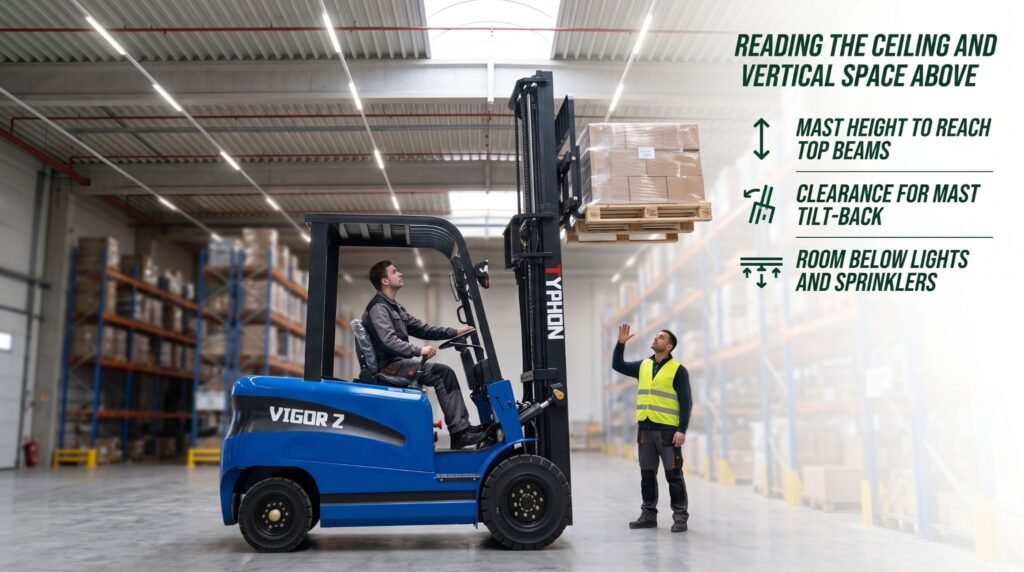
Mast selection matters here in a practical way. Forklifts can be configured with full free-lift masts that raise the forks a significant distance before the overall height of the machine increases, which matters enormously in facilities with limited overhead clearance or low doorways between zones. If the TYPHON VIGOR will travel through dock doorways, into refrigerated areas, or under mezzanines with the load still raised, a free-lift mast configuration protects both the load and the building. Measure the ceiling height at the lowest point on every route, then confirm the mast and load height stay within that figure with a safe margin. What this means: match the TYPHON VIGOR’s mast type and maximum raised height to the lowest overhead clearance in the facility, since a forklift that can lift high but can’t travel with a raised load slows every put-away cycle.
Clearing the Loading Dock and Entry Points
Access is the entry point every other measurement has to pass through, since a machine that can’t reach the storage area is worthless no matter how capable it is once inside. Loading docks, roll-up doors, and inter-building passages all funnel the TYPHON VIGOR through fixed openings, and those openings dictate the maximum width, height, and sometimes length the machine can present as it passes through. Compact forklifts in this class are sized to pass through standard commercial dock doors, but older facilities and retrofitted warehouses sometimes present narrower or lower openings that need checking.
Measurement here has to be precise rather than estimated. Measure the clear opening of each doorway or dock door at its tightest point, accounting for door frames, weather seals, dock bumpers, and any raised threshold that reduces the usable width at floor level. A machine even an inch too wide or a mast an inch too tall simply doesn’t go through, and forcing the fit damages both the entry point and the unit. Trace the entire path from the receiving dock to the farthest storage aisle, because a single low lintel or a tight interior doorway anywhere on that route can halt the plan. Key takeaway: measure the clear width and height of every dock door and interior entry point on the operating route, then confirm the TYPHON VIGOR’s dimensions clear each one with room to spare, since reaching the racking is the first practical test any warehouse forklift has to pass.
Reaching the Loads Once You’re Inside
Productivity depends on more than fitting through the door, because the forklift also has to reach the pallets it came to move. Working reach describes how high the forks can lift, how far forward the mast can extend, and how precisely the carriage can be positioned to slot a load into a rack beam or lower it onto a dock plate. A forklift with a generous lift height and good forward reach covers more of the racking from a single lane position, while a shorter reach forces operators to reposition or leaves upper rack levels unused.
Side shift and fork spread attachments factor into reach just as much as mast height. A side-shift carriage lets the operator nudge the load left or right without repositioning the whole machine, which dramatically speeds up pallet placement in tight rack bays and reduces the risk of clipping a beam. On a busy receiving dock, the ability to square a pallet quickly without backing up and re-approaching saves meaningful time across a full shift. Confirm which attachments the TYPHON VIGOR supports and how they affect the overall machine width in the working position, since some attachments add to the footprint in ways the base dimensions don’t show. What this means: match the TYPHON VIGOR’s lift height, mast reach, and available attachments to the rack configuration and pallet types in your facility, since working reach determines how much of the storage area one machine covers without constant repositioning.
Making Room to Stage and Park the Machine
Logistics close out the space question, because the TYPHON VIGOR still has to charge, wait, and park safely between tasks. Charging or fuel access requires a dedicated spot with enough clearance to maneuver the machine in and out without blocking a traffic lane, and that spot needs to sit away from pedestrian paths and fire exits as codes and common sense both require. A compact forklift takes up less floor area than a large counterbalanced lift, yet it still needs a flat, clear space that lets the operator dismount safely and walk away from the machine without stepping into a travel lane.
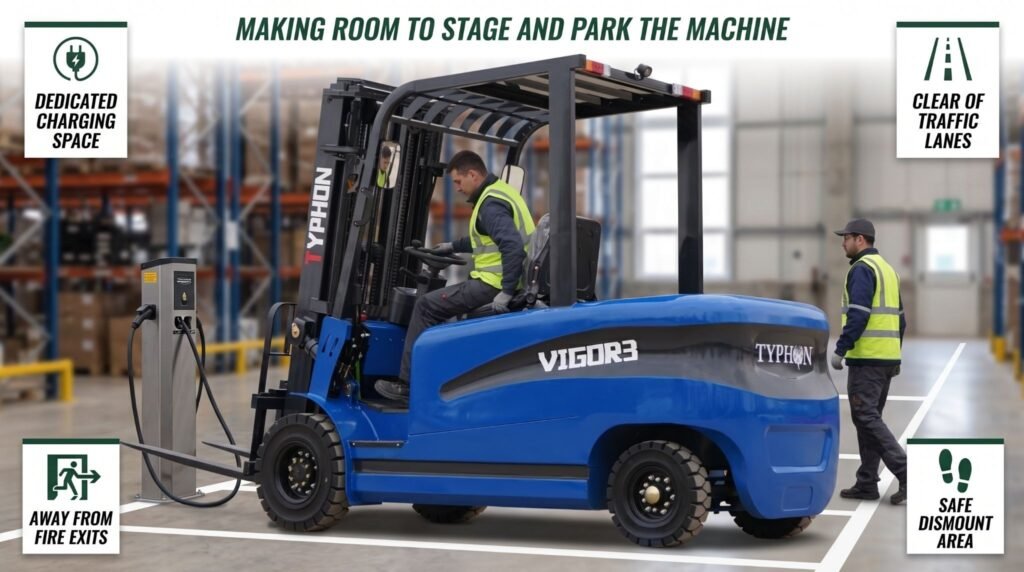
Staging is the operational space nobody plans for until it runs short. When a receiving shift peaks, inbound pallets need a clear floor area to land before they move to permanent locations, and that staging area has to sit within easy reach of the dock without blocking the cross-aisle that connects the rest of the floor. Set aside a flat, marked area for pallet staging, keep the charging or parking spot visible and accessible from the main travel lanes, and confirm the dock approach allows the forklift to back a loaded pallet off a truck without swinging into a racking bay. Key takeaway: plan the floor space for charging, staging, and parking as carefully as the space for lifting, since a facility with nowhere to safely land pallets or park the machine between tasks bottlenecks the whole operation before the first load moves.
Conclusion
Figuring out how much space a TYPHON VIGOR forklift needs is rarely a guess once you work through the considerations in order, from the machine outward to the whole facility. Start with the physical footprint, since the length, width, and height in both travel and raised positions set the floor for everything else, then confirm the turning radius so the machine can pivot cleanly at every aisle end and intersection. Match the mast height and configuration to the lowest overhead clearance on every route, measure every dock door and interior opening the forklift has to pass through, and confirm the lift height and attachments cover the full rack layout from where the machine can stand. Finally, carve out marked space for charging, pallet staging, and safe parking so the machine operates without creating bottlenecks. Run through those checks in sequence and you will know the TYPHON VIGOR fits and functions well before it arrives on the floor, rather than discovering a clearance problem with the first loaded pallet in the air. Before your next receiving shift, measure your tightest aisle, your lowest doorway, and your staging area so the TYPHON VIGOR works at full capacity from the first cycle to the last. When you’re ready to put a dependable, right-sized forklift to work, or need help matching one to your facility layout, reach out to a trusted equipment specialist who can pair the right unit with the results your operation depends on.
Frequently Asked Questions
Will a TYPHON VIGOR forklift fit in a standard warehouse aisle?
In most cases, yes, provided you measure the clear aisle width against the machine’s turning radius rather than just its body width. Standard pallet-rack aisles are typically designed with counterbalanced forklift dimensions in mind, but the rear of the machine swings outward during a turn, sweeping an arc wider than the body width suggests. Measure the TYPHON VIGOR’s published turning radius and compare it to your tightest aisle end and intersection, accounting for rack uprights and any column faces that reduce usable width. If your storage layout runs narrower than the turning radius requires, a reach truck or narrow-aisle configuration may be a better fit for those zones.
How much overhead clearance does a TYPHON VIGOR need to operate safely?
It depends on both the mast configuration and the lift height your racking demands. At a minimum, the machine needs enough clearance to raise a loaded pallet to the highest beam level with a safe margin above, plus adequate height in travel position as it moves through dock doors, mezzanine openings, and other low-clearance points. A free-lift mast lets the forks rise a significant distance before the overall machine height increases, which helps in facilities with limited overhead room. Measure the ceiling at the lowest point on every route the forklift will travel, check that figure against the mast height in both travel and fully raised positions, and confirm all sprinkler heads, lighting fixtures, and structural beams sit safely above the machine’s highest reach.
How do I plan staging and parking space for a TYPHON VIGOR in a busy warehouse?
Start by identifying a flat, clear floor area close to the receiving dock for inbound pallet staging, making sure it sits outside the main travel lanes so a full staging row never blocks cross-aisle access. Parking and charging or fuel access need a dedicated spot that the operator can maneuver into and out of without swinging into a rack bay or a pedestrian path, and that spot should comply with local fire and safety codes regarding distances from exits and hazard areas. Mark all staging, travel, and parking zones clearly on the floor, keep the dock approach free of parked loads that would force the forklift to swing wide, and review the layout whenever storage volumes change, since a floor plan that works at normal inventory levels can tighten quickly when receiving peaks.
