Choosing Attachments to Maximize Mini Excavator Uses
Unexpected Mini Excavator Uses: Demolition, Drilling & More
Most people picture a mini excavator doing one thing: digging. And it’s true, these compact machines dig trenches and footings like champs. But if that’s all you use yours for, you’re leaving serious value on the table. The right attachments turn a mini excavator into one of the most versatile tools on any job site.
Contractors who understand this get more work done with fewer machines. That means lower equipment costs, less transport hassle, and better margins. From knocking down small structures to boring holes for fence posts, your mini excavator can tackle jobs you might currently hire out or handle by hand.
Contractors, landscapers, farmers, and property owners are increasingly choosing mini excavators because a single machine can handle a wide range of tasks throughout the year. Instead of investing in multiple specialized pieces of equipment, swapping the right attachment lets you move from excavation and grading to demolition, material handling, or land clearing in minutes. Understanding which attachments are available and when to use them helps you maximize productivity, improve return on investment, and get more value from every hour your machine operates.
Demolition: Tearing Down Made Simple
Demolition is one of the most underrated uses for a mini excavator. While you won’t be leveling office towers, these machines shine on residential and light commercial teardowns. Think old sheds, decks, concrete pads, and interior gut jobs.
The compact size that makes mini excavators great for tight digging also makes them ideal for demolition in cramped spaces. You can maneuver through gates, work inside partially standing structures, and operate where a full-size machine simply won’t fit.
Small Structure and Concrete Breaking
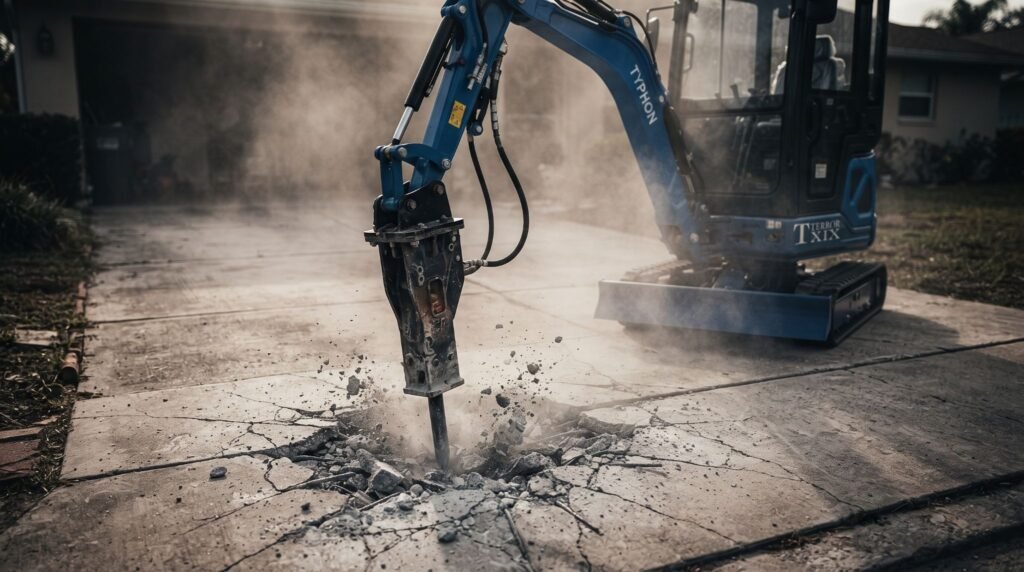
With a hydraulic breaker attachment, your mini excavator becomes a powerful demolition tool. The breaker delivers repeated hammer blows that shatter concrete slabs, foundations, and masonry with ease. What used to take a crew with jackhammers all day now takes a fraction of the time.
Pair the breaker with a standard bucket for cleanup, and you’ve got a complete demolition workflow. Break the material, then scoop and load the debris straight into a dump trailer. One operator, one machine, starts to finish.
Interior and Selective Demolition
Compact machines are perfect for selective demolition, where you tear out part of a structure while keeping the rest intact. Because they’re small and precise, mini excavators let you remove walls, flooring, or fixtures without damaging surrounding areas.
Electric and low-emission models make this even better for indoor work. You avoid the exhaust fumes of larger equipment, which matters when you’re operating inside an enclosed building. Just confirm the floor can support the machine’s weight before you roll in.
Drilling and Auger Work
Digging holes by hand is slow, exhausting, and hard on your crew. A mini excavator equipped with an auger attachment changes that completely. It bores clean, consistent holes in seconds, turning a backbreaking task into a quick pass.
Auger attachments come in a variety of diameters to match different jobs. Smaller bits are ideal for fence posts and landscaping, while larger sizes handle deck footings, utility poles, and foundation work. Choosing the right auger helps create clean, consistent holes while saving time and reducing manual labor.
Fence Posts and Deck Footings
Setting fence posts is one of the most common auger applications. The mini excavator’s hydraulic power drives the auger through soil, clay, and even light rock far faster than a two-person post-hole digger. You get uniform depth and clean sidewalls every time.
Deck and pergola footings work the same way. Consistent hole depth means consistent concrete, which translates to a stronger, safer finished structure. Your clients notice that quality, and it keeps them coming back.
Sign Posts, Trees, and Foundations
Beyond fencing, augers handle sign installation, tree planting, and small foundation work. Landscapers use them to plant dozens of trees in the time it would take to dig a handful by hand. The precision also reduces soil disturbance around the planting site.
For light foundation jobs, augers bore the pier holes needed for small buildings and additions. Match the auger diameter to your engineering specs, and you’ll produce clean holes ready for rebar and concrete.
Land Clearing and Brush Removal
Clearing overgrown lots, removing stumps, and tackling brush are jobs a mini excavator handles surprisingly well. The right attachment lets you clear a site faster and with less physical strain than manual methods.
This versatility is one reason mini excavators are popular with landscaping and site preparation crews. A single machine can clear brush and debris, then quickly switch to grading, trenching, or digging without bringing in additional equipment.
Stump and Root Removal
A grapple or a strong bucket makes quick work of stumps and root balls. You can dig around the base, sever roots, and lift the whole stump free without renting a dedicated stump grinder. For larger stumps, a thumb attachment gives you the grip needed to wrestle them loose.
Removing roots and stumps completely also prevents regrowth and future damage. Clients appreciate a clean site that won’t sprout problems down the road.
Brush, Trees, and Debris
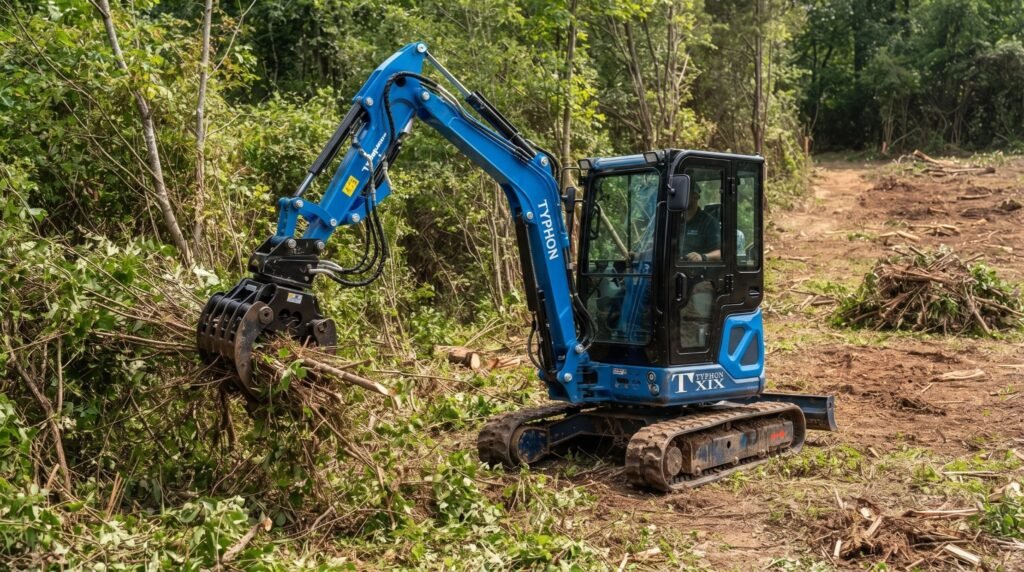
Grapple attachments turn your mini excavator into a brush-clearing machine. You can grab tangled branches, small trees, and piles of debris, then stack or load them for hauling. This beats dragging brush by hand, and it keeps your crew safer around thorny or heavy material.
For denser vegetation, some operators add a mulching or cutter attachment. According to the U.S. Forest Service, proper vegetation management reduces wildfire risk and improves land health, so clearing overgrowth serves more than just aesthetics.
Snow Removal: Keep Earning Through Winter
When the ground freezes and excavation work slows, your mini excavator doesn’t have to sit idle. With the right snow blade or snow pusher attachment, it becomes an effective machine for clearing snow from driveways, parking lots, sidewalks, and other paved areas, helping you stay productive throughout the winter.
This is one of the best ways to maximize your equipment investment. Instead of leaving the machine parked for months, you can keep it generating income during the off-season while reducing the need to purchase or rent dedicated snow removal equipment.
Blades, Buckets, and Pushing Snow
A standard bucket pushes and piles snow effectively for smaller jobs. For larger areas, a dedicated snow blade or pusher attachment moves more volume in each pass. The mini excavator’s maneuverability lets you clear tight spots that full-size plows can’t reach.
Commercial clients with small parking lots and private drives often need this exact service. Offering winter snow removal keeps your name in front of customers year-round and smooths out seasonal income gaps.
Landscaping and Grading
Landscaping goes well beyond planting and clearing. Mini excavators excel at the shaping, grading, and material-moving tasks that create a polished finished site. The precision of a compact machine makes fine work achievable.
Because mini excavators have a compact footprint and lower ground pressure than larger equipment, they’re well suited for established properties. They can complete the work efficiently while minimizing damage to lawns, gardens, and finished landscaping.
Grading and Leveling
With a grading bucket or a tilt attachment, your mini excavator smooths and levels ground with impressive accuracy. This is essential for prepping sites for patios, driveways, and garden beds. A level base means fewer problems and a better-looking result.
Fine grading also improves drainage. By shaping the ground to direct water away from structures, you protect your client’s property and add real value to your service.
Trenching for Irrigation and Utilities
Landscapers frequently trench for irrigation lines, drainage pipes, and low-voltage lighting. A narrow trenching bucket cuts clean, precise channels exactly where you need them. This keeps disruption minimal and backfill simple.
The same trenching ability serves utility work, from water lines to electrical conduit. Consistent trench depth and width make installation faster and reduce the risk of damaging what you bury.
Choosing the Right Attachments
The secret to unlocking all these uses is matching attachments to your workload. Buying every attachment at once rarely makes sense. Instead, start with the tools that fit the jobs you take on most often, then expand as your services grow.
Consider your machine’s hydraulic capacity and weight rating before purchasing. Not every attachment works with every mini excavator, so confirm compatibility to avoid underperformance or damage. When in doubt, check with your dealer for guidance on the right fit.
Frequently Asked Questions
What attachments do I need to expand my mini excavator’s uses?
Start with the basics for your most common jobs. A hydraulic breaker handles demolition, an auger covers drilling, and a grapple manages land clearing. Add specialty attachments like snow blades or grading buckets as your services expand.
Can a mini excavator really handle demolition work?
Yes, for small to mid-size jobs. Mini excavators excel at residential teardowns, concrete breaking, and interior demolition. They won’t replace heavy equipment on large structures, but for compact and selective work, they’re often the better choice.
Conclusion
A mini excavator is much more than a digging machine. With the right attachments, it can handle demolition, drilling, land clearing, snow removal, and precision landscaping, making it one of the most versatile machines on any job site. This flexibility allows contractors to complete more work with a single piece of equipment.
The contractors who get the most value from their machines are the ones who think beyond the standard bucket. By selecting the right attachment for each task, you can take on a wider variety of projects, reduce equipment rental costs, and improve productivity throughout the year. Every new attachment expands what your machine can do and increases its return on investment.
Getting the most from a mini excavator means looking beyond its standard configuration. Expanding its capabilities with the right attachments helps improve flexibility, increase productivity, and make every hour of operation more valuable.
Most people picture a mini excavator doing one thing: digging. And it’s true, these compact machines dig trenches and footings like champs. But if that’s all you use yours for, you’re leaving serious value on the table. The right attachments turn a mini excavator into one of the most versatile tools on any job site.
Contractors who understand this get more work done with fewer machines. That means lower equipment costs, less transport hassle, and better margins. From knocking down small structures to boring holes for fence posts, your mini excavator can tackle jobs you might currently hire out or handle by hand.
Contractors, landscapers, farmers, and property owners are increasingly choosing mini excavators because a single machine can handle a wide range of tasks throughout the year. Instead of investing in multiple specialized pieces of equipment, swapping the right attachment lets you move from excavation and grading to demolition, material handling, or land clearing in minutes. Understanding which attachments are available and when to use them helps you maximize productivity, improve return on investment, and get more value from every hour your machine operates.
Demolition: Tearing Down Made Simple
Demolition is one of the most underrated uses for a mini excavator. While you won’t be leveling office towers, these machines shine on residential and light commercial teardowns. Think old sheds, decks, concrete pads, and interior gut jobs.
The compact size that makes mini excavators great for tight digging also makes them ideal for demolition in cramped spaces. You can maneuver through gates, work inside partially standing structures, and operate where a full-size machine simply won’t fit.
Small Structure and Concrete Breaking
With a hydraulic breaker attachment, your mini excavator becomes a powerful demolition tool. The breaker delivers repeated hammer blows that shatter concrete slabs, foundations, and masonry with ease. What used to take a crew with jackhammers all day now takes a fraction of the time.
Pair the breaker with a standard bucket for cleanup, and you’ve got a complete demolition workflow. Break the material, then scoop and load the debris straight into a dump trailer. One operator, one machine, starts to finish.
Interior and Selective Demolition
Compact machines are perfect for selective demolition, where you tear out part of a structure while keeping the rest intact. Because they’re small and precise, mini excavators let you remove walls, flooring, or fixtures without damaging surrounding areas.
Electric and low-emission models make this even better for indoor work. You avoid the exhaust fumes of larger equipment, which matters when you’re operating inside an enclosed building. Just confirm the floor can support the machine’s weight before you roll in.
Drilling and Auger Work
Digging holes by hand is slow, exhausting, and hard on your crew. A mini excavator equipped with an auger attachment changes that completely. It bores clean, consistent holes in seconds, turning a backbreaking task into a quick pass.
Auger attachments come in a variety of diameters to match different jobs. Smaller bits are ideal for fence posts and landscaping, while larger sizes handle deck footings, utility poles, and foundation work. Choosing the right auger helps create clean, consistent holes while saving time and reducing manual labor.
Fence Posts and Deck Footings
Setting fence posts is one of the most common auger applications. The mini excavator’s hydraulic power drives the auger through soil, clay, and even light rock far faster than a two-person post-hole digger. You get uniform depth and clean sidewalls every time.
Deck and pergola footings work the same way. Consistent hole depth means consistent concrete, which translates to a stronger, safer finished structure. Your clients notice that quality, and it keeps them coming back.
Sign Posts, Trees, and Foundations
Beyond fencing, augers handle sign installation, tree planting, and small foundation work. Landscapers use them to plant dozens of trees in the time it would take to dig a handful by hand. The precision also reduces soil disturbance around the planting site.
For light foundation jobs, augers bore the pier holes needed for small buildings and additions. Match the auger diameter to your engineering specs, and you’ll produce clean holes ready for rebar and concrete.
Land Clearing and Brush Removal
Clearing overgrown lots, removing stumps, and tackling brush are jobs a mini excavator handles surprisingly well. The right attachment lets you clear a site faster and with less physical strain than manual methods.
This versatility is one reason mini excavators are popular with landscaping and site preparation crews. A single machine can clear brush and debris, then quickly switch to grading, trenching, or digging without bringing in additional equipment.
Stump and Root Removal
A grapple or a strong bucket makes quick work of stumps and root balls. You can dig around the base, sever roots, and lift the whole stump free without renting a dedicated stump grinder. For larger stumps, a thumb attachment gives you the grip needed to wrestle them loose.
Removing roots and stumps completely also prevents regrowth and future damage. Clients appreciate a clean site that won’t sprout problems down the road.
Brush, Trees, and Debris
Grapple attachments turn your mini excavator into a brush-clearing machine. You can grab tangled branches, small trees, and piles of debris, then stack or load them for hauling. This beats dragging brush by hand, and it keeps your crew safer around thorny or heavy material.
For denser vegetation, some operators add a mulching or cutter attachment. Proper vegetation management reduces wildfire risk and improves land health, so clearing overgrowth serves more than just aesthetics.
Snow Removal: Keep Earning Through Winter
When the ground freezes and excavation work slows, your mini excavator doesn’t have to sit idle. With the right snow blade or snow pusher attachment, it becomes an effective machine for clearing snow from driveways, parking lots, sidewalks, and other paved areas, helping you stay productive throughout the winter.
This is one of the best ways to maximize your equipment investment. Instead of leaving the machine parked for months, you can keep it generating income during the off-season while reducing the need to purchase or rent dedicated snow removal equipment.
Blades, Buckets, and Pushing Snow
A standard bucket pushes and piles snow effectively for smaller jobs. For larger areas, a dedicated snow blade or pusher attachment moves more volume in each pass. The mini excavator’s maneuverability lets you clear tight spots that full-size plows can’t reach.
Commercial clients with small parking lots and private drives often need this exact service. Offering winter snow removal keeps your name in front of customers year-round and smooths out seasonal income gaps.
Landscaping and Grading
Landscaping goes well beyond planting and clearing. Mini excavators excel at the shaping, grading, and material-moving tasks that create a polished finished site. The precision of a compact machine makes fine work achievable.
Because mini excavators have a compact footprint and lower ground pressure than larger equipment, they’re well suited for established properties. They can complete the work efficiently while minimizing damage to lawns, gardens, and finished landscaping.
Grading and Leveling
With a grading bucket or a tilt attachment, your mini excavator smooths and levels ground with impressive accuracy. This is essential for prepping sites for patios, driveways, and garden beds. A level base means fewer problems and a better-looking result.
Fine grading also improves drainage. By shaping the ground to direct water away from structures, you protect your client’s property and add real value to your service.
Trenching for Irrigation and Utilities
Landscapers frequently trench for irrigation lines, drainage pipes, and low-voltage lighting. A narrow trenching bucket cuts clean, precise channels exactly where you need them. This keeps disruption minimal and backfill simple.
The same trenching ability serves utility work, from water lines to electrical conduit. Consistent trench depth and width make installation faster and reduce the risk of damaging what you bury.
Choosing the Right Attachments
The secret to unlocking all these uses is matching attachments to your workload. Buying every attachment at once rarely makes sense. Instead, start with the tools that fit the jobs you take on most often, then expand as your services grow.
Consider your machine’s hydraulic capacity and weight rating before purchasing. Not every attachment works with every mini excavator, so confirm compatibility to avoid underperformance or damage. When in doubt, check with your dealer for guidance on the right fit.
Frequently Asked Questions
- What attachments do I need to expand my mini excavator’s uses? Start with the basics for your most common jobs. A hydraulic breaker handles demolition, an auger covers drilling, and a grapple manages land clearing. Add specialty attachments like snow blades or grading buckets as your services expand.
- Can a mini excavator really handle demolition work? Yes, for small to mid-size jobs. Mini excavators excel at residential teardowns, concrete breaking, and interior demolition. They won’t replace heavy equipment on large structures, but for compact and selective work, they’re often the better choice.
Conclusion
A mini excavator is much more than a digging machine. With the right attachments, it can handle demolition, drilling, land clearing, snow removal, and precision landscaping, making it one of the most versatile machines on any job site. This flexibility allows contractors to complete more work with a single piece of equipment.
The contractors who get the most value from their machines are the ones who think beyond the standard bucket. By selecting the right attachment for each task, you can take on a wider variety of projects, reduce equipment rental costs, and improve productivity throughout the year. Every new attachment expands what your machine can do and increases its return on investment.
Getting the most from a mini excavator means looking beyond its standard configuration. Expanding its capabilities with the right attachments helps improve flexibility, increase productivity, and make every hour of operation more valuable.
📐 Landscaping, Grading, and Core Mini Excavator Uses
Landscaping goes well beyond planting and clearing. Mini excavators excel at the shaping, grading, and material-moving tasks that create a polished finished site. The precision of a compact machine makes fine work achievable.
Because mini excavators have a compact footprint and lower ground pressure than larger equipment, they’re well suited for established properties. They can complete the work efficiently while minimizing damage to lawns, gardens, and finished landscaping, proving that precision grading is among the most valuable mini excavator uses.
Grading and Leveling
With a grading bucket or a tilt attachment, your mini excavator smooths and levels ground with impressive accuracy. This is essential for prepping sites for patios, driveways, and garden beds. A level base means fewer problems and a better-looking result.
Fine grading also improves drainage. By shaping the ground to direct water away from structures, you protect your client’s property and add real value to your service.
Trenching for Irrigation and Utilities
Landscapers frequently trench for irrigation lines, drainage pipes, and low-voltage lighting. A narrow trenching bucket cuts clean, precise channels exactly where you need them. This keeps ground disruption minimal and backfill simple.
The same trenching ability serves utility work, from water lines to electrical conduit. Consistent trench depth and width make installation faster and reduce the risk of damaging what you bury.
🔧 Choosing Attachments to Maximize Mini Excavator Uses
The secret to unlocking all these diverse mini excavator uses is matching attachments to your workload. Buying every attachment at once rarely makes sense. Instead, start with the tools that fit the jobs you take on most often, then expand as your services grow.
Consider your machine’s hydraulic capacity and weight rating before purchasing. Not every attachment works with every machine configuration, so confirm compatibility to avoid underperformance or damage. When in doubt, check with your dealer for guidance on how to safely expand your mini excavator uses.
