Mini Excavator Size Guide: Finding the Perfect Fit in 2026
Mini Excavator Size Guide: Finding the Perfect Fit
The right mini excavator size makes a job feel effortless. The wrong one turns every shift into a fight — too small and you overwork the machine, too large and you can’t get it through the gate or onto a soft lawn without leaving damage behind. Either way, the mismatch costs you time, money, and patience.
This guide helps contractors, landscapers, property owners, rental buyers, and equipment shoppers find the size that fits their actual work. We break down the four main size classes, explain what each one handles best, and walk through the factors that should drive your decision. By the end, you’ll know exactly which class to focus on before you start comparing models.
Why Size Comes First
Every other specification — dig depth, hydraulic flow, bucket width, lift capacity — only matters once you’ve picked the right size class. Size sets the boundaries for what the machine can do, where it can go, and what it costs to own and operate.
Get size right and the rest of your decision falls into place naturally. Size determines:
- What you can dig and how fast you move material
- Where the machine fits — gates, alleys, indoor spaces, soft ground
- What trailer and tow vehicle you need to move it
- How much fuel you burn per hour
- Which attachments the machine can run effectively
- Your total ownership cost over the years you keep it
Start here, and you’ll avoid the two most expensive mistakes in the category: buying more machine than the work justifies, or buying too little and limiting the jobs you can take on.
The Four Mini Excavator Size Classes
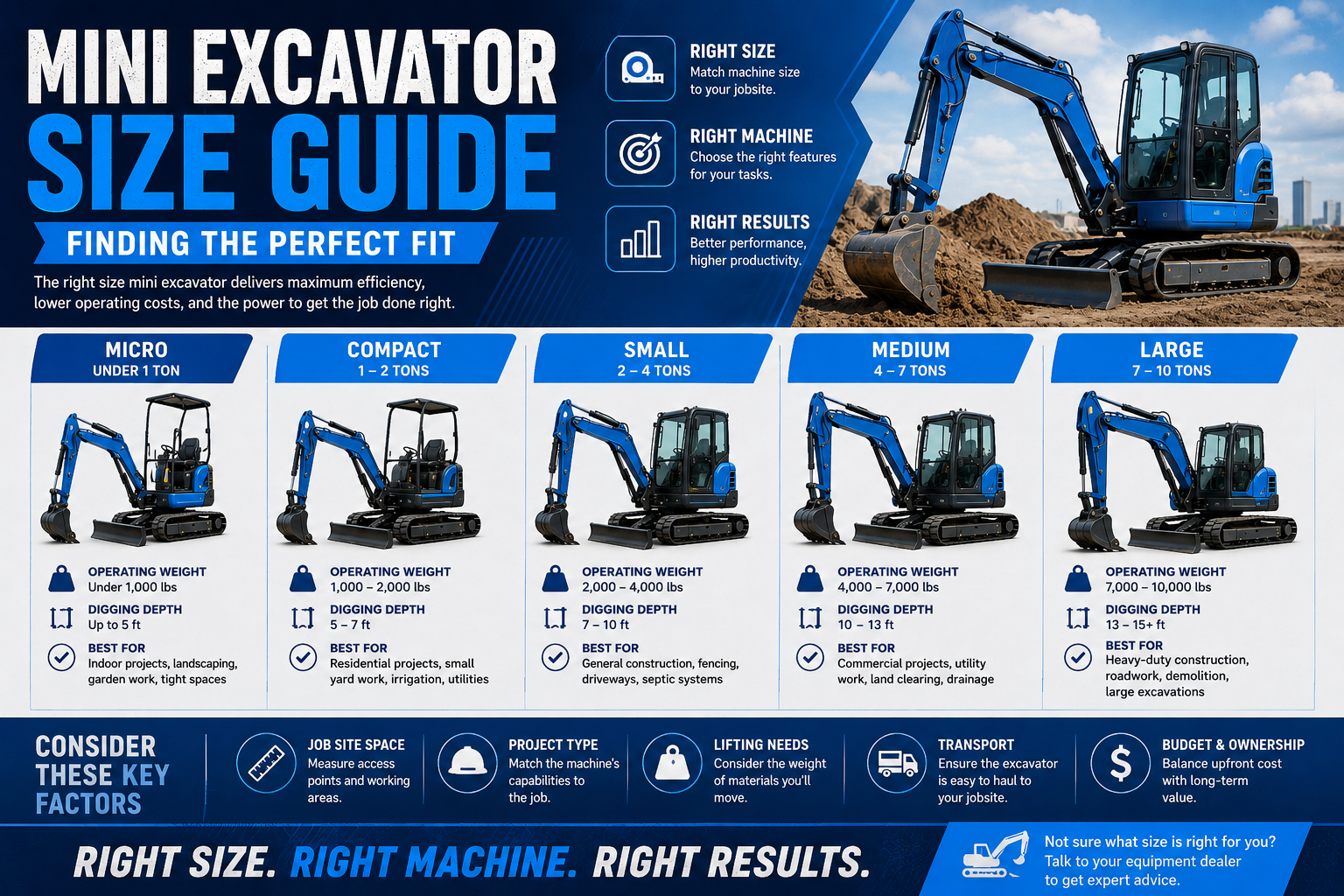
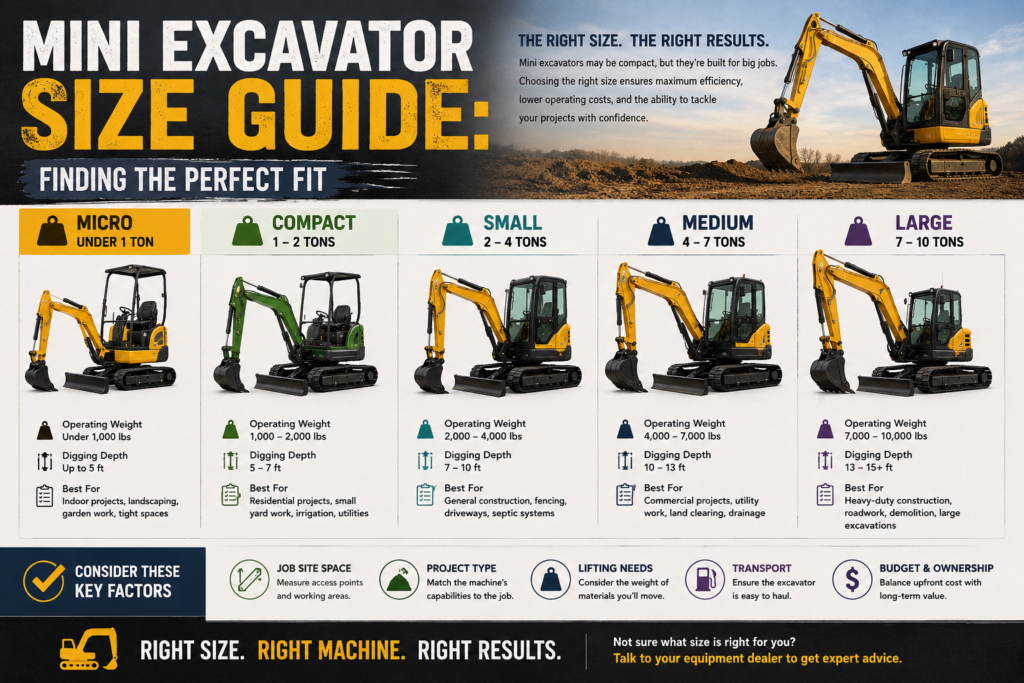
Mini excavators are grouped by operating weight. Here’s how the classes break down and where each one performs best.
Sub-Compact: Under 2 Tons
Operating weight: roughly 2,000 to 4,000 lbs
These are the smallest machines in the category, built for maximum access with minimal footprint. They slip through standard fence gates, work inside buildings, and operate on finished surfaces and soft turf without leaving deep ruts behind.
Best suited for:
- Residential landscaping and garden work
- Indoor demolition and utility installation
- Tight backyard access through narrow gates
- Light trenching for irrigation, drainage, and electrical lines
- Small grading and cleanup tasks
Where they reach their limit: Sub-compact machines have modest dig force and reach. Dense clay, deep utility trenches, or sustained production work will push them harder than they’re designed for, which shows up in slower cycles and faster wear.
Transport: Most sub-compact models tow easily behind a standard pickup on a single-axle trailer — ideal for contractors hopping between several small residential jobs in a day.
Compact: 2 to 4 Tons
Operating weight: roughly 4,000 to 9,000 lbs
This is the most popular class in the market, and the reason is simple: it delivers a practical balance of dig force, reach, and maneuverability without becoming hard to transport or restricted on access. For a huge share of contractors and landscapers, this is the sweet spot.
Best suited for:
- Residential and light commercial landscaping
- Utility trenching for water, sewer, and electrical work
- Fence post and deck foundation work
- Small drainage and pond projects
- General land clearing on smaller parcels
Where they reach their limit: Heavier clay, rock, and deeper trenches are within reach, but production rates drop compared to a larger class working the same conditions.
Transport: Most models in this range move on a tandem-axle trailer behind a heavy-duty pickup. Check your trailer’s rated capacity against the machine’s operating weight, including any attachments you haul.
Mid-Size: 4 to 6 Tons
Operating weight: roughly 9,000 to 13,000 lbs
Step up to this class and you gain real increases in dig force, reach, lift capacity, and stability. These machines handle heavier material and deeper digging without straining, making them a strong choice for production-level work.
Best suited for:
- Commercial site preparation and grading
- Deeper utility trenches — water mains, sewer lines, storm drainage
- Foundation excavation on residential and light commercial projects
- Demolition support and material handling
- Road repair and infrastructure work
Where they reach their limit: Site access and surface protection require more planning. These machines are heavier than a typical residential lot expects, and not every driveway or turf area handles the ground pressure cleanly.
Transport: Plan on a larger tandem-axle or gooseneck trailer with a tow vehicle rated for the load. Confirm road and bridge weight limits on your usual routes.
Upper Compact: 6 to 10 Tons
Operating weight: roughly 13,000 to 22,000 lbs
At the top of the category, these machines deliver serious dig force, deep reach, and strong lift capacity while staying more maneuverable than full-size excavators. They bridge the gap between compact convenience and full-scale production power.
Best suited for:
- Heavy commercial excavation
- Infrastructure projects including roads and stormwater systems
- Deeper foundation and basement digging
- High-production utility work
- Medium-scale commercial demolition
Where they reach their limit: Site access becomes a genuine constraint. These machines need adequate clearance, firm ground or ground protection, and careful transport planning. In some regions, loads at this weight require transport permits or approved routes.
Transport: A gooseneck trailer with the right rated capacity and a capable tow vehicle is standard. Verify permit requirements in your area before moving equipment at this weight.
Match Digging Depth to Your Work
Once you have a size class in mind, dig depth helps confirm the fit. Match the machine’s rated depth to your typical excavation — not a theoretical maximum that’s only reachable in perfect positioning.
| Application | Typical Required Dig Depth |
|---|---|
| Landscaping and grading | 3 to 5 feet |
| Shallow drainage and irrigation | 4 to 6 feet |
| Utility lines (water, electrical) | 5 to 8 feet |
| Sewer and storm drain installation | 8 to 12 feet |
| Foundation and basement work | 10 feet or more |
Build in a margin. A machine that just barely meets your depth requirement at full extension will struggle at the comfortable working angles you actually use day to day.
Factor in Lift Capacity
If your work involves more than moving dirt — setting pipe, placing heavy material, lifting tree stumps or large rocks — lift capacity becomes a key filter. Larger size classes carry more weight at height, which matters when you’re placing pipe into a deep trench or loading a haul truck.
Check lift capacity at full reach and full height, not just at ground level. Ratings drop as the boom extends, so confirm the machine holds up where you’ll actually be lifting.
Consider Jobsite Access and Terrain
A machine that can’t reach the work is the wrong machine, regardless of its specs.
Walk the site before you choose. Measure the narrowest entry point — gate openings, gaps between structures, low overhead clearances. Many compact mini excavators offer a retractable undercarriage that narrows for tight passage and widens for stability during operation. For access under 36 to 40 inches, this feature moves from helpful to necessary.
Terrain shapes your undercarriage choice. Rocky, abrasive ground accelerates track wear and demands more durable components. Soft or waterlogged ground benefits from wider tracks that spread the machine’s weight and prevent sinking. Steep grades call for adequate tractive force and reliable braking. When conditions fall outside the ordinary, talk them through with your dealer before committing to a size.
Weigh Tail Swing Against Your Workspace
Tail swing — how far the rear counterweight extends beyond the tracks during rotation — directly affects how closely the machine can work next to walls, fences, and structures. It’s a size-related decision that’s easy to overlook.
- Conventional tail swing works well on open sites with room to spare. The counterweight extends well past the tracks, limiting how close you can rotate to a structure.
- Reduced tail swing offers a practical middle ground — better clearance without giving up much stability.
- Zero tail swing (ZTS) keeps the counterweight within the track footprint through a full 360-degree rotation. It’s essential for urban sites, enclosed areas, and any work within inches of a building or retaining wall.
If your projects regularly put the machine close to structures, prioritize reduced or zero tail swing within your target size class. On open ground, conventional tail swing performs fine and often costs less.
Plan for Transport Requirements
Every step up in size adds transport complexity. Here’s a practical snapshot:
| Size Class | Typical Transport Setup |
|---|---|
| Sub-compact (under 2 tons) | Pickup + single-axle trailer |
| Compact (2 to 4 tons) | Heavy-duty pickup + tandem-axle trailer |
| Mid-size (4 to 6 tons) | Heavy-duty truck + larger tandem or gooseneck trailer |
| Upper compact (6 to 10 tons) | Gooseneck trailer, permit may be required |
Beyond trailer capacity, confirm:
- Loading ramp angle relative to the machine’s ground clearance
- Loaded machine height against bridge and overhead clearances on your routes
- Weight limits on the roads and bridges you’ll travel
- Move time and cost between sites, especially if you run multiple locations per day
A larger machine that adds time and expense to every job move compounds into a real cost across a full work season. If you stay on one site for weeks at a time, transport matters less and you can lean into machine capability instead.
Confirm Attachment Compatibility
Attachment compatibility depends on size in two ways: the coupler has to fit, and the hydraulic system has to deliver enough flow and pressure to run the tool.
Larger machines generally provide higher auxiliary hydraulic flow, supporting more demanding attachments like hydraulic breakers, tiltrotators, and high-flow augers. Sub-compact and compact machines handle standard buckets, light augers, and compaction plates well, but may fall short on flow for the most demanding tools.
Before locking in a size:
- List every attachment you plan to run
- Confirm the flow and pressure each one requires
- Verify the machine’s auxiliary circuit meets those specs at your target size class
Choosing a machine that can’t power your most important attachment forces an early — and expensive — upgrade.
Build a Total Cost of Ownership View
Purchase price is the most visible number, but it tells only part of the story. Total cost of ownership (TCO) shows what the machine truly costs over the years you operate it.
A complete TCO picture includes:
- Purchase price or financing cost
- Fuel consumption across your typical operating hours — larger machines burn more
- Routine maintenance including filters, fluids, grease, and scheduled service
- Undercarriage wear — tracks, rollers, and sprockets are a major ongoing cost, and replacement on a larger machine costs significantly more
- Attachment investment and upkeep
- Unplanned repairs and warranty coverage
- Resale or residual value when you trade or sell
Size influences nearly every line on that list. A bigger machine than your work requires drives up fuel, maintenance, and transport costs without delivering matching returns. A machine sized correctly for your typical workload keeps your cost per hour — and per project — where it should be.
How Ownership Type Shapes the Decision
If you’re renting for a single project, keep it simple: identify the smallest size that safely meets your requirements and rent that. You’re not paying to keep idle capacity between jobs.
If you’re buying for regular use, think across your full project mix — not just the job in front of you. Size for your most common application, then rent up when an occasional larger job demands it. Buying a machine sized for your heaviest work, when that work is a small slice of your annual volume, ties up capital in capacity you rarely use.
A reliable rule of thumb: Size for your typical job. Rent up for the exceptions. Avoid over-specifying for the rare heavy project.
Find the Fit That Matches Your Work
The right mini excavator size handles your typical dig depth, fits your most common access points, moves on a trailer you can manage, and runs the attachments your projects need — all at a total cost that supports your bottom line.
Work through this short framework to land on the right class:
- Define your typical work — what you dig, how deep, and in what conditions
- Identify your access constraints — gates, surface sensitivity, overhead clearances
- Confirm your transport setup — trailer capacity, permits, daily job volume
- Check dig depth and lift capacity against your real requirements
- Evaluate tail swing based on how tight your typical workspace is
- Verify attachment compatibility for every tool you plan to run
Be honest about how you actually work. The contractors and owners who get the most from their equipment size to their real demands — not to a hypothetical maximum or the temptation to save a few dollars on a machine that’s too small. Match the size to the work, and the right class becomes clear.
If you’re still weighing two classes, talk it through with your equipment dealer. A dealer who understands your jobsite conditions and project mix can help you confirm the fit before you commit — and that conversation is well worth having before the machine shows up on site.
Mini Excavator Size Guide: Finding the Perfect Fit in 2026
The right mini excavator size makes a job feel effortless. The wrong one turns every shift into a fight — too small and you overwork the machine, too large and you can’t get it through the gate or onto a soft lawn without leaving expensive damage behind. Either way, the mismatch costs you time, money, and patience.
As the global compact equipment market reaches new heights in 2026, driven by intense urban construction and landscaping demand, the options can feel overwhelming. In fact, market forecasts project the global compact excavator market to reach $16.9 billion this year. This guide helps contractors, landscapers, property owners, and equipment shoppers find the mini excavator size that fits their actual work.
We’ll break down the four main size classes, explain what each one handles best, and walk through the factors that should drive your decision. By the end, you’ll know exactly which weight class to focus on before you start comparing individual mini excavator features.
Why Mini Excavator Size Comes First
Every other specification — dig depth, hydraulic flow, bucket width, lift capacity — only matters once you’ve picked the right mini excavator size. Size sets the boundaries for what the machine can do, where it can go, and what it costs to own and operate.
Get the mini excavator size right, and the rest of your decision falls into place naturally. Determining the correct mini excavator size dictates:
- What you can dig and how fast you move material.
- Where the machine fits (gates, alleys, indoor spaces, soft ground).
- What trailer and tow vehicle you need to move it.
- How much fuel you burn per hour.
- Which attachments the machine can run effectively.
- Your total ownership cost over the years you keep it.
Start here, and you’ll avoid the two most expensive mistakes in the category: buying more machine than the work justifies, or buying too little and limiting the jobs you can take on.
The Four Mini Excavator Size Classes
When shopping for new or used equipment, machines are grouped by operating weight. Here’s how the mini excavator size classes break down and where each one performs best.
1. Sub-Compact: Under 2 Tons
(Operating weight: roughly 2,000 to 4,000 lbs)
These are the smallest machines in the category, built for maximum access with a minimal footprint. They slip through standard 36-inch fence gates, work inside buildings, and operate on finished surfaces and soft turf without leaving deep ruts behind.
- Best suited for: Residential landscaping, indoor demolition, backyard access, and light trenching.
- Limitations: Modest dig force and reach. Dense clay or sustained production work will result in slower cycles and faster wear.
- Transport: Tows easily behind a standard pickup on a single-axle trailer.
2. Compact: 2 to 4 Tons
(Operating weight: roughly 4,000 to 9,000 lbs)
This is the most popular mini excavator size in the market. In fact, industry data highlights that over the last five years, 3 to 4-ton mini excavators have been the most popular mini excavator size class in the North American rental industry, effectively representing around one-third of worldwide usage. It delivers a practical balance of dig force, reach, and maneuverability without becoming hard to transport or restricted on access.
- Best suited for: Residential and light commercial landscaping, utility trenching, fence post work, and small drainage projects.
- Limitations: Heavier clay, rock, and deeper trenches are reachable, but production rates drop compared to a larger class.
- Transport: Moves on a tandem-axle trailer behind a heavy-duty pickup.
3. Mid-Size: 4 to 6 Tons
(Operating weight: roughly 9,000 to 13,000 lbs)
Step up to this mini excavator size, and you gain real increases in dig force, reach, lift capacity, and stability. These machines handle heavier material and deeper digging without straining, making them a strong choice for production-level work.
- Best suited for: Commercial site preparation, deeper utility trenches (water mains, sewer lines), and foundation excavation.
- Limitations: Site access requires more planning. These machines are heavier than a typical residential lot expects, and not every driveway or turf area handles the ground pressure cleanly.
- Transport: Requires a larger tandem-axle or gooseneck trailer with a heavy-duty tow vehicle.
4. Upper Compact: 6 to 10 Tons
(Operating weight: roughly 13,000 to 22,000 lbs)
At the top of the category, this mini excavator size delivers serious dig force and strong lift capacity while staying more maneuverable than full-size crawler excavators. They bridge the gap between compact convenience and full-scale production power.
- Best suited for: Heavy commercial excavation, infrastructure projects, high-production utility work, and medium-scale demolition.
- Limitations: Site access becomes a genuine constraint. In some regions, loads at this weight require transport permits.
- Transport: A gooseneck trailer with an appropriately rated commercial tow vehicle is standard.
Factor in Lift Capacity and Tail Swing
Lift Capacity
If your work involves setting pipe, placing heavy material, or lifting tree stumps, lift capacity becomes a key filter. A larger mini excavator size carries more weight at height. Check lift capacity at full reach and full height, not just at ground level. Ratings drop as the boom extends.
Tail Swing
Tail swing directly affects how closely the machine can work next to walls and fences.
- Conventional Tail Swing: Works well on open sites and often costs less.
- Zero Tail Swing (ZTS): Keeps the counterweight within the track footprint through a full 360-degree rotation. It’s essential for urban sites and enclosed areas.
Jobsite Access and Terrain
A machine that can’t reach the work is the wrong machine. Walk the site before you choose. Measure the narrowest entry point—especially standard 36-inch residential gates. Many sub-compact machines offer a retractable undercarriage that narrows for tight passage and widens for stability.
Furthermore, terrain shapes your undercarriage choice. Soft or waterlogged ground benefits from wider rubber tracks that spread the machine’s weight, while rocky, abrasive ground demands durable steel components. If you’re working under strict noise ordinances or indoor environments in 2026, you may also want to explore the rapidly growing electric mini excavator size options available on the market today. Electric machines are capturing up to 10% of mini-excavator sales in some sectors, providing equivalent breakout force with zero local emissions. For more details on the transition to electric machinery, you can review current guidelines from the Association of Equipment Manufacturers (AEM).
Plan for Transport Requirements
Every step up in mini excavator size adds transport complexity. Here’s a practical snapshot:
| Size Class | Typical Transport Setup |
| Sub-compact (< 2 tons) | Pickup + single-axle trailer |
| Compact (2 to 4 tons) | Heavy-duty pickup + tandem-axle trailer |
| Mid-size (4 to 6 tons) | Heavy-duty truck + larger tandem/gooseneck trailer |
| Upper compact (6 to 10 tons) | Gooseneck trailer (Permit may be required) |
A larger machine that adds time and expense to every job move compounds into a real cost across a full work season. Confirm loading ramp angles, loaded machine heights, and road weight limits before purchasing.
Build a Total Cost of Ownership View
Purchase price is only part of the story. Total cost of ownership (TCO) shows what the machine truly costs over the years you operate it. A complete TCO picture includes:
- Purchase price or financing cost.
- Fuel consumption (a larger mini excavator size burns more).
- Routine maintenance (filters, fluids, grease).
- Undercarriage wear and replacement costs.
- Attachment investment and upkeep.
Your chosen mini excavator size influences nearly every line on that list. A bigger machine than your work requires drives up fuel, maintenance, and transport costs without delivering matching returns.
Find the Fit That Matches Your Work
If you’re renting for a single project, keep it simple: identify the smallest mini excavator size that safely meets your requirements. You’re not paying to keep idle capacity between jobs. If you’re buying a machine for regular use, size for your most common application, then rent up when an occasional larger job demands it.
To find the perfect mini excavator size, work through this short framework:
- Define your typical work (what you dig, how deep, and in what conditions).
- Identify your access constraints (measure those gate openings!).
- Confirm your transport setup.
- Check dig depth and lift capacity against your real requirements.
- Verify attachment compatibility for every tool you plan to run.
Be honest about how you actually work. Match the mini excavator size to the work, and the right class becomes clear. If you’re still weighing two classes, talk it through with your equipment dealer to ensure you’re making a profitable, long-term decision.
