The 2026 Tech Advantage
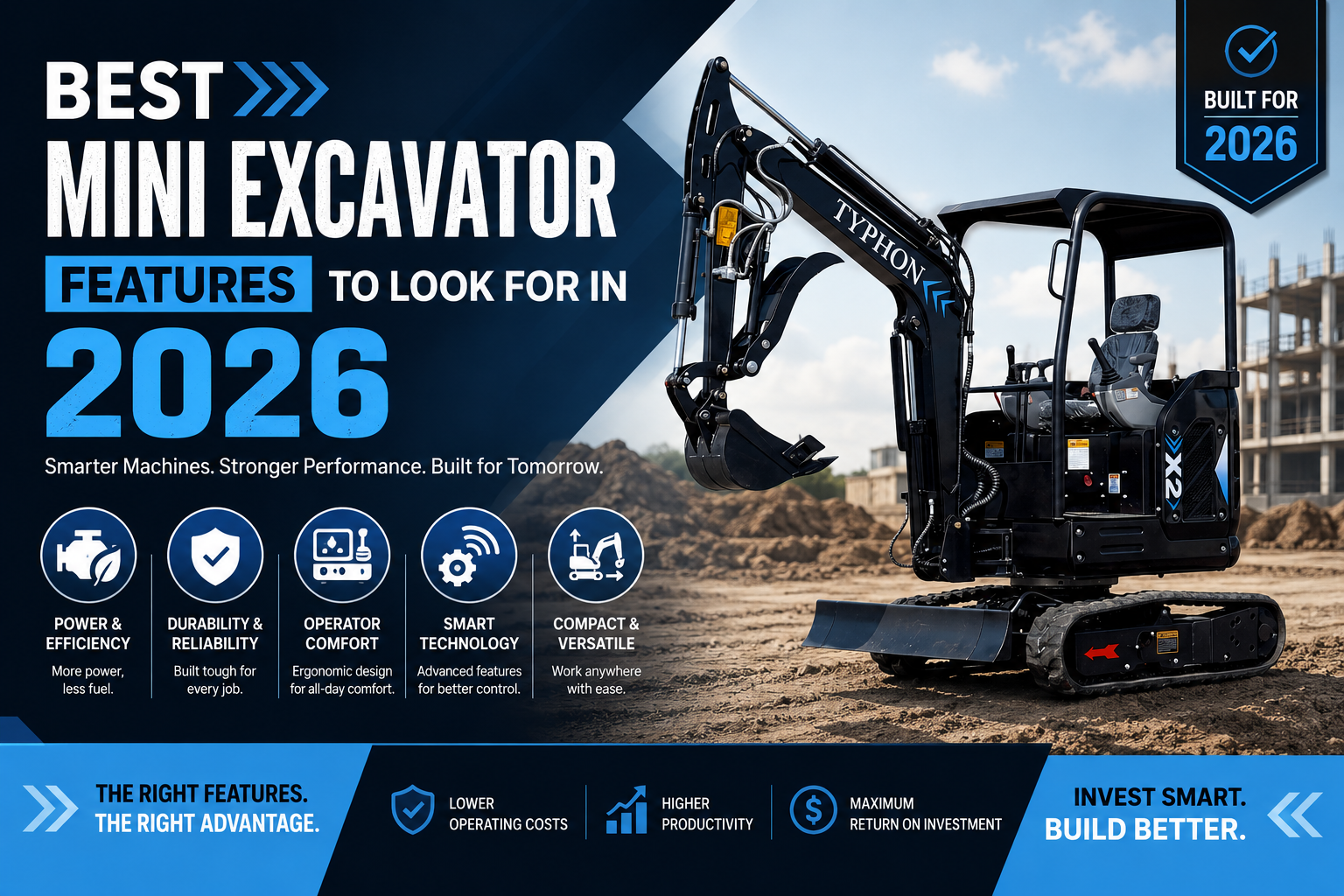
Best Mini Excavator Features to Look for in 2026
Mini excavators are in high demand this year, and that demand is reshaping what buyers expect from these machines. With strong sales across rental fleets, landscaping crews, and construction operations, manufacturers have packed more capability into compact frames than ever before. The challenge isn’t finding a mini excavator — it’s choosing one with the right features for your work.
Pick the wrong feature set and you pay for it daily: poor access on tight sites, weak hydraulic flow that limits attachments, or a cab that wears out your operators by midafternoon. Pick the right features and you get a machine that earns its keep on every job.
This guide breaks down the features that matter most in 2026. You’ll learn what each feature does, why it matters, and how to decide whether it belongs on your shortlist.
Why Features Matter More Than Ever in 2026
Demand for mini excavators is strong heading into 2026, with active markets across both new and used machines. More buyers are entering the category, and more models are competing for their attention.
That competition is good for you — but only if you know what to look for. A lower price tag means little if the machine lacks the hydraulic flow your attachments need or the dealer support to keep it running. Features determine real-world productivity, and productivity determines whether the machine pays for itself.
The smart approach: match features to your actual jobsite demands, not to a spec sheet that looks impressive on paper.
Zero Tail Swing for Confined Spaces
Zero tail swing (ZTS) keeps the rear counterweight within the track width during a full rotation.
This feature is essential if your work brings the machine close to walls, fences, utilities, or parked vehicles. With ZTS, operators can rotate a full 360 degrees without worrying about the back end clipping a structure.
For urban jobs, residential lots, and any site where clearance is tight, zero tail swing moves from “nice to have” to “required.” On wide-open sites with room to spare, conventional tail swing works fine and may cost less. Match the configuration to where you actually dig.
Retractable Undercarriage for Tight Access
A retractable undercarriage narrows the machine for transport and passage through tight openings, then widens for stability during operation.
This feature is a real advantage for contractors who work in confined spaces. Many compact models can shrink their track width to fit through a standard fence gate, then expand to give the machine a stable, planted base while digging.
You might be thinking: “Do I really need this?” If your jobs regularly involve access points under 36 to 40 inches, the answer is yes. If you mostly work on open sites, you can prioritize other features instead.
Hydraulic Performance and Auxiliary Flow
Hydraulic performance determines how powerfully and smoothly the machine digs, lifts, and runs attachments.
Two machines with similar engine output can feel completely different in the seat. The difference usually comes down to the hydraulic system. When evaluating hydraulics, focus on:
- Hydraulic flow rate — higher flow supports faster cycles and more demanding attachments
- System pressure — higher pressure generates more breakout and lift force
- Auxiliary circuits — required for powered tools like breakers, augers, and tiltrotators
- Proportional controls — smooth, precise command for fine grading work
If you plan to run powered attachments, confirm the auxiliary circuit delivers enough flow and pressure for each tool. A machine that can’t drive your most important attachment forces an early upgrade.
Digging Depth and Lift Capacity
These two performance numbers define what the machine can actually accomplish on your jobs.
Digging Depth
Match the rated dig depth to your typical work, not a theoretical maximum. A machine that barely reaches your required depth in ideal positioning will struggle at normal working angles.
General depth guidelines by application:
- Landscaping and grading: 3 to 5 feet
- Drainage and irrigation: 4 to 6 feet
- Water and electrical lines: 5 to 8 feet
- Sewer and storm drains: 8 to 12 feet
Lift Capacity
If your work involves placing pipe, setting heavy material, or lifting at height, check the machine’s lift capacity — and confirm it holds up at full reach, not just at ground level. Ratings often drop as the boom extends.
Attachment Compatibility and Quick Coupler Systems
A mini excavator’s versatility comes from its attachments. The right coupler system lets you switch tools fast and keep the machine working across multiple tasks.
Quick coupler systems allow operators to change attachments quickly — often without leaving the cab. This matters when a single job requires a bucket, then an auger, then a breaker.
Before buying, confirm:
- The machine supports a quick coupler that fits your attachment lineup
- The hydraulic flow and pressure meet each attachment’s requirements
- The manufacturer offers a broad attachment catalog, or third-party options fit cleanly
A machine with limited compatibility locks you into a narrower range of work and a weaker return on investment.
Operator Cab Comfort and Visibility
A comfortable operator with clear sightlines works faster, safer, and longer. These features are easy to overlook on a spec sheet but obvious within the first week on site.
For comfort, look at cab ergonomics, seat quality, control layout, and effective heating and cooling. Reduced noise and vibration cut fatigue across long shifts.
For visibility, prioritize clear sightlines to the bucket cutting edge and minimal blind spots around the machine. Camera and sensor options add awareness when working in tight, congested areas. Better visibility means cleaner work and a safer site for everyone around the machine.
Telematics and Onboard Diagnostics
Telematics has become a standard expectation in 2026, and for good reason.
Onboard systems track machine hours, fuel use, fault codes, and maintenance alerts in real time. For fleet managers running multiple machines across multiple sites, that visibility is a major operational advantage. You can schedule service proactively, catch small issues before they become breakdowns, and monitor utilization across the fleet.
Takeaway: If you manage more than one machine, weight telematics heavily. The data pays for itself in reduced downtime.
Fuel Efficiency
Fuel is a recurring cost that adds up fast across operating hours. Modern mini excavators use several technologies to stretch every gallon:
- Load-sensing hydraulics that match output to demand
- Automatic idle and auto-shutdown features
- Engine management that optimizes fuel delivery under load
When comparing models, ask the dealer for real-world consumption data for work similar to yours. Rated horsepower tells you little about how much fuel the machine burns doing actual work.
Undercarriage Durability
The undercarriage — tracks, rollers, and sprockets — represents one of the largest ongoing ownership costs on any mini excavator.
Abrasive, rocky terrain accelerates wear and drives up replacement costs. If your sites are tough on tracks, prioritize durable undercarriage components and the right track type for your conditions. Rubber tracks suit finished surfaces and residential work, while steel tracks handle rock and demolition better.
Matching the undercarriage to your terrain protects both performance and your long-term budget.
Ease of Maintenance
A machine that’s hard to service costs you more than repair bills — it costs you uptime.
When evaluating serviceability, ask:
- Can daily checks be completed quickly and safely from the ground?
- Are filters, fluids, and grease points easy to reach?
- Do access panels open fully for unobstructed service?
Simple, accessible maintenance keeps machines running and reduces the temptation to defer service. A well-maintained machine outperforms and outlasts a more complex one that gets neglected.
Common Mistakes to Avoid
- Over-specifying “just in case.” A heavier machine than you need damages surfaces, burns more fuel, and complicates transport.
- Ignoring attachment hydraulics. Confirm flow and pressure before you buy, not after the tool won’t run.
- Skipping the dealer check. A feature-rich machine with distant service support becomes a liability the first time it breaks down.
- Judging by spec sheet alone. How a machine feels during a demo reveals more than any printed number.
Match Features to Your Jobsite Before You Buy
The strong mini excavator market in 2026 gives you more capable machines and more options than ever. That’s an advantage — but only when you choose features that fit how you actually work.
Start with your real jobsite demands. If you work in tight spaces, prioritize zero tail swing and a retractable undercarriage. If attachments drive your productivity, focus on hydraulic flow and quick coupler compatibility. If you manage a fleet, weight telematics and ease of maintenance heavily. And no matter what, confirm your dig depth, lift capacity, and dealer support match the work in front of you.
Build a short list of must-have features based on your typical projects, then test candidate machines on your own site with your own materials whenever possible. The right combination of features — matched honestly to your work — is what turns a mini excavator into a dependable, profitable part of your operation for years to come.
When you’re ready to compare specific models, bring this feature checklist to your dealer and ask the hard questions. The machine that earns your confidence through those conversations is the one worth buying.
Best Mini Excavator Features to Look for in 2026
When shopping for compact construction equipment this year, prioritizing the right mini excavator features is essential. Mini excavators are in high demand, and that demand is reshaping what buyers expect from these machines. With strong sales across rental fleets, landscaping crews, and construction operations, manufacturers have packed more capability into compact frames than ever before.
The challenge isn’t finding a machine — it’s choosing one with the exact setup for your work. Pick the wrong setup and you pay for it daily: poor access on tight sites, weak hydraulic flow that limits attachments, or a cab that wears out your operators by midafternoon. Pick the right mini excavator features, and you get a machine that earns its keep on every job.
This guide breaks down the capabilities that matter most in 2026. You’ll learn what each feature does, why it matters, and how to decide whether it belongs on your shortlist.
Why Mini Excavator Features Matter More Than Ever
Demand for compact equipment is strong heading into 2026, with active markets across both new and used machines. More buyers are entering the category, and more models are competing for your attention.
That competition is good for you — but only if you know what to look for. A lower price tag means little if the machine lacks the hydraulic flow your attachments need or the dealer support to keep it running. Evaluating mini excavator features determines real-world productivity, and productivity determines whether the machine pays for itself.
According to recent 2026 market analysis, global mini excavator sales are projected to reach $16.9 billion this year, driven by urban construction demands and landscaping projects. The smart approach: match the feature set to your actual jobsite demands, not to a spec sheet that looks impressive on paper.
Essential Mini Excavator Features for Confined Spaces
Zero Tail Swing (ZTS)
Zero tail swing (ZTS) keeps the rear counterweight within the track width during a full rotation.
This is one of the most popular mini excavator features because it allows operators to rotate a full 360 degrees without worrying about the back end clipping a structure. It is essential if your work brings the machine close to walls, fences, utilities, or parked vehicles.
For urban jobs, residential lots, and any site where clearance is tight, zero tail swing moves from “nice to have” to “required.” On wide-open sites with room to spare, conventional tail swing works fine and may cost less.
Retractable Undercarriage
A retractable undercarriage narrows the machine for transport and passage through tight openings, then widens for stability during operation.
If your jobs regularly involve access points under 36 to 40 inches, this is one of the mini excavator features you simply cannot skip. Many compact models can shrink their track width to fit through a standard fence gate, then expand to give the machine a stable, planted base while digging.
Power, Hydraulics, and Performance Metrics
Hydraulic Performance and Auxiliary Flow
Hydraulic performance determines how powerfully and smoothly the machine digs, lifts, and runs attachments. Two machines with similar engine output can feel completely different in the seat, making hydraulics one of the most critical mini excavator features to test.
When evaluating hydraulics, focus on:
- Hydraulic flow rate: Higher flow supports faster cycles and more demanding attachments.
- System pressure: Higher pressure generates more breakout and lift force.
- Smart Attachment Recognition: A leading 2026 trend where the machine automatically adjusts hydraulic flow and pressure based on the tool being used.
Digging Depth and Lift Capacity
These two performance numbers define what the machine can actually accomplish on your jobs. Match the rated dig depth to your typical work, not a theoretical maximum. A machine that barely reaches your required depth in ideal positioning will struggle at normal working angles.
| Application | Recommended Digging Depth |
| Landscaping & Grading | 3 to 5 feet |
| Drainage & Irrigation | 4 to 6 feet |
| Water & Electrical Lines | 5 to 8 feet |
| Sewer & Storm Drains | 8 to 12 feet |
The 2026 Tech Advantage: AI and Electrification
In 2026, manufacturers are moving beyond basic hydraulic machines toward connected, semi-autonomous construction equipment.
Telematics, GPS Control, and Onboard Diagnostics
Modern digital technologies can drastically reduce fuel use and improve accuracy. Telematics has become a standard expectation. Onboard systems track machine hours, fuel use, fault codes, and maintenance alerts in real time.
Additionally, GPS machine control helps operators dig to the required depth and slope more consistently. This reduces unnecessary digging, minimizes over-break, and cuts the number of cycles needed to reach final formation.
Electric and Hybrid Powertrains
Environmental regulations are pushing manufacturers toward electric and hybrid technologies. If you work indoors, in residential areas, or under strict noise ordinances, an electric powertrain is one of the most vital mini excavator features to consider. They offer zero local emissions, lower noise levels, and reduced maintenance costs.
If fully electric isn’t feasible, hybrid models are emerging as a practical middle ground, combining diesel engines with electric motors.
Operator Cab Comfort and Visibility
A comfortable operator works faster, safer, and longer. Look for cab ergonomics, suspension seats, and intuitive joystick layouts. For visibility, prioritize clear sightlines to the bucket cutting edge. In 2026, advanced 360-degree camera systems and proximity sensors are becoming standard options, drastically improving awareness when working in congested areas.
Ease of Maintenance and Undercarriage Durability
The undercarriage represents one of the largest ongoing ownership costs. If your sites are tough on tracks, prioritize durable undercarriage components. Rubber tracks suit finished surfaces and residential work, while steel tracks handle rock and demolition better.
A machine that’s hard to service costs you more than repair bills — it costs you uptime. When evaluating serviceability as a part of your essential mini excavator features, ask:
- Can daily checks be completed quickly and safely from the ground?
- Are filters, fluids, and grease points easy to reach?
For more insights on keeping your equipment running efficiently, check out industry guides on preventive maintenance to ensure your machine stays in peak condition.
Match Mini Excavator Features to Your Jobsite Before You Buy
The strong equipment market in 2026 gives you more capable machines and more options than ever. That’s an advantage — but only when you choose the right mini excavator features that fit how you actually work.
Start with your real jobsite demands. If you work in tight spaces, prioritize zero tail swing and a retractable undercarriage. If attachments drive your productivity, focus on hydraulic flow and quick coupler compatibility. Build a short list of must-have requirements based on your typical projects, then contact our sales team to test candidate machines on your own site whenever possible. The right combination of mini excavator features will turn your new machine into a dependable, profitable part of your operation for years to come.
