Which One Is Right for You?
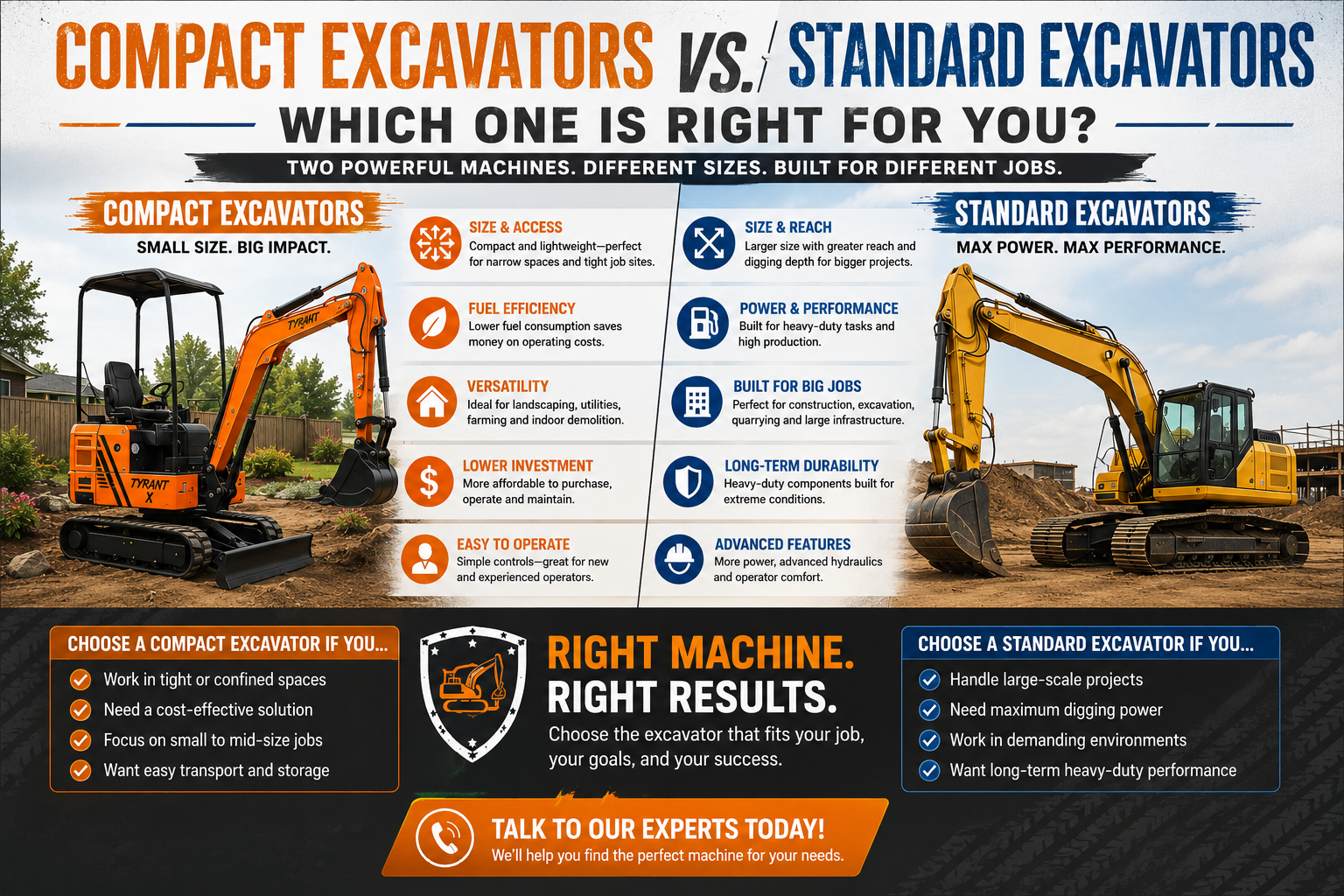
Compact Excavators vs. Standard Excavators: Which One Is Right for You?
Choosing between a compact excavator and a standard excavator is one of the most consequential equipment decisions you will make on a project. Pick the wrong machine and you either lose productive hours fighting an undersized tool or spend money transporting a full-size excavator onto a site that cannot accommodate it.
Both machine types are built to dig, but they are engineered for very different scales of work. This guide breaks down the key differences so contractors, equipment buyers, fleet managers, and site supervisors can match the right machine to the right job.
Here is what we cover:
- How compact and standard excavators differ in size, power, and capability
- Which applications suit each machine type best
- How jobsite conditions, transport needs, and ownership costs should drive your decision
How Size and Operating Weight Define the Choice
The most obvious difference between compact and standard excavators is physical size — and that difference shapes everything else.
Compact excavators (also called mini excavators) typically weigh between 1 and 10 metric tons. Most of the work done in this category falls in the 2–6 ton range. These machines are designed to operate in confined spaces, access restricted sites, and move between jobs without heavy transport equipment.
Standard excavators generally start around 14 metric tons and scale up well beyond 30 tons for large production machines. They are built for volume — moving significant quantities of material efficiently on open, well-prepared sites.
Operating weight is not just a transport concern. It directly affects ground pressure, surface damage risk, and stability under load. A 3-ton compact machine can operate on finished surfaces, soft turf, and narrow access paths where a 20-ton standard excavator would cause serious damage or simply cannot reach.
Digging Power and Reach: Where Standard Excavators Pull Ahead
When raw digging capability is the priority, standard excavators have a clear advantage.
Standard excavators deliver substantially higher breakout force, deeper maximum dig depth, and greater reach. A mid-size standard excavator can reach 20 feet or more below grade with strong bucket curl force throughout the dig cycle. This matters on deep utility installations, large foundation excavations, and high-production earthmoving where volume and speed are the primary performance metrics.
Compact excavators are more capable than their size suggests, but their limits are real. Most compact machines max out at 10–14 feet of dig depth, with lower breakout force that shows itself clearly in hard clay, compacted soil, or rocky ground. They are effective on shallow to mid-depth utility work, landscaping, and site prep — but pushing them beyond their rated depth or into extremely resistant material extends cycle times and accelerates wear.
The practical rule: If your typical excavation depth exceeds 12 feet or your material is consistently dense and resistant, a standard excavator will deliver meaningfully better production rates.
Site Access and Maneuverability: Where Compact Excavators Win
This is where compact excavators earn their place in the market — and often justify their cost even on projects where a larger machine would dig faster.
Compact excavators can pass through standard fence gates, operate in residential backyards, work inside structures, and function in urban environments where site boundaries are tight. Their zero tail swing configurations allow them to rotate within the machine’s own footprint, making them safe to operate directly next to walls, fences, and utilities.
Standard excavators require significantly more room. Their counterweights extend well beyond the track width during rotation, and their overall footprint demands a working radius that many constrained sites simply cannot provide. Positioning a full-size excavator near a building foundation or within a fenced residential lot creates real collision risk and surface damage.
Common applications where compact excavators are the only practical option:
- Backyard landscaping or drainage projects with narrow gate access
- Urban utility trenching along active streets
- Indoor demolition or basement excavation
- Work near existing structures, retaining walls, or landscaping
- Sites with overhead clearance constraints
If your project has any of these characteristics, a compact excavator is not just convenient — it is the correct tool.
Transport Requirements: A Hidden Cost Difference
Moving equipment between job sites is a real operational cost. Compact and standard excavators have very different transport profiles.
Compact excavators in the 2–6 ton class can typically be hauled on a tandem-axle trailer pulled by a heavy-duty pickup. Setup is fast, transport costs are modest, and most crews can move a compact machine between jobs within the same workday without disrupting the schedule.
Standard excavators require purpose-built lowboy trailers, heavy tow vehicles, and — depending on machine weight — transport permits, route approvals, and sometimes escort vehicles. Moving a 20-ton machine between two job sites in the same day is a logistical exercise that adds cost and planning complexity.
For contractors managing multiple smaller sites across a service area, the transport flexibility of a compact machine directly affects profitability. For operations based on a single large site for weeks at a time, transport frequency matters less and machine capability becomes the dominant factor.
Attachment Versatility: Compact Machines Are More Capable Than You Might Think
Both machine types support a wide range of attachments, but there are meaningful differences in what each can power effectively.
Compact excavators support:
- Trenching and grading buckets in varying widths
- Hydraulic breakers for light-to-medium demolition
- Augers for post holes, piers, and plantings
- Grapples for material handling and land clearing
- Compaction plates for trench backfill
- Tiltrotators for precision grading work
Standard excavators support all of the above — and extend further into heavy-duty territory. They power larger hydraulic hammers capable of breaking reinforced concrete and solid rock, high-flow attachments that require flow rates beyond compact machine capacity, and heavy grapples and material handlers suited to demolition and large-scale material management.
If your attachment use is primarily standard buckets, light breakers, and augers, a compact machine likely handles your needs. If you regularly run large-diameter augers, heavy hydraulic hammers, or high-flow specialty tools, verify that your machine’s auxiliary hydraulic circuit meets the tool’s requirements — and in many cases, a standard excavator will be the more capable platform.
Fuel Consumption and Operating Costs
Day-to-day operating costs favor compact excavators in the right application — but the comparison requires context.
Compact excavators consume significantly less fuel per hour than standard machines. A 5-ton compact might burn 1.5–2.5 gallons per hour under load. A 20-ton standard excavator can consume 5–8 gallons per hour or more in demanding conditions. Over a full work season, that difference is substantial.
However, fuel efficiency only tells part of the story. If a compact machine needs twice as many hours to complete the same volume of work as a standard excavator, the fuel savings are offset by additional labor, machine time, and potential project delays. True cost efficiency comes from matching the machine’s output capacity to the project’s production demand.
For light-to-medium work volumes, compact excavators deliver better operating cost per hour and per project. For high-volume production environments, standard excavators deliver better cost per ton of material moved — even with higher fuel consumption.
Maintenance and Ownership Considerations
Both machine types share similar maintenance fundamentals: daily inspections, greasing, fluid and filter changes, and undercarriage care. The differences lie in scale and complexity.
Compact excavators are generally simpler to maintain. Service points are accessible, routine tasks are straightforward, and maintenance can often be completed without a lift or special tooling. Parts costs are lower, and many compact machine owners handle basic service in-house.
Standard excavators involve more complex systems, larger fluid capacities, and maintenance tasks that typically require more time and equipment. Dealer technician involvement is more common for scheduled service, and parts costs reflect the larger, more complex machine.
Undercarriage wear — tracks, rollers, and sprockets — is a significant ongoing cost for both types. Abrasive terrain accelerates wear on any excavator, but the replacement cost on a standard machine’s larger undercarriage components is substantially higher than on a compact machine.
For fleet managers evaluating total cost of ownership, build a five-year cost model that includes fuel, scheduled maintenance, undercarriage replacement, and anticipated repairs. The purchase price difference between compact and standard machines is often significant, and lower ongoing costs on the compact side can make it the stronger long-term investment for the right application.
When to Choose a Compact Excavator
A compact excavator is the right choice when:
- Site access is restricted — narrow gates, confined spaces, or urban environments
- Surface protection matters — finished hardscapes, turf, or soft ground that cannot support heavy machine weight
- Dig depth stays under 12 feet for most of your work
- The project scale is light to mid-range — residential, landscaping, utility, or small commercial
- Transport flexibility is important — moving between multiple sites with a standard trailer setup
- Zero tail swing is required — working within inches of structures or utilities
When to Choose a Standard Excavator
A standard excavator is the right choice when:
- Production volume is high — moving large quantities of material efficiently
- Dig depth regularly exceeds 12 feet or material is dense and resistant
- The project is large-scale — major infrastructure, large foundations, or earthmoving contracts
- Heavy attachments are required — large hydraulic hammers, high-flow tools, or heavy grapples
- The site is open and well-prepared — space and access are not limiting factors
- Long-term site presence reduces transport frequency — the machine stays on site for weeks or months
Match the Machine to the Work
Compact and standard excavators are not competitors in most practical scenarios — they serve different ends of the market effectively and with clear purpose. The contractors and fleet managers who get the best return from their equipment are those who select machines based on honest assessments of their actual project mix, not on a general preference for larger or smaller equipment.
Start with your most common application: typical dig depth, site access constraints, daily production targets, and transport realities. If your work is primarily light-to-medium utility, landscaping, and residential construction, a compact excavator will deliver better access, lower transport costs, and competitive operating efficiency. If you are managing high-volume earthmoving, deep utility installation, or major infrastructure work, a standard excavator’s additional power and reach will justify the investment.
When in doubt, talk to your equipment dealer about your specific project conditions. A well-informed dealer can help you evaluate the right machine type and size class before you commit — and that conversation is worth having before the equipment arrives on site.
Compact Excavators vs. Standard Excavators: Which One Is Right for You?
When evaluating compact excavators vs. standard excavators, you are making one of the most consequential equipment decisions for your jobsite. Pick the wrong machine, and you either lose productive hours fighting an undersized tool or waste money transporting a full-size excavator onto a site that cannot accommodate it.
The debate between compact excavators vs. standard excavators usually comes down to the scale of your work. This guide breaks down the key differences so contractors, fleet managers, and site supervisors can confidently match the right machine to the right job. If you are looking to expand your lineup, be sure to check out our comprehensive heavy equipment rental fleet for current availability.
Quick Comparison: Compact Excavators vs. Standard Excavators
To start the compact excavators vs. standard excavators comparison, let’s look at the baseline specs:
| Feature | Compact (Mini) Excavators | Standard Excavators |
| Operating Weight | 1 to 10 metric tons | 14 to 30+ metric tons |
| Max Dig Depth | 10 to 14 feet | 20+ feet |
| Transport | Standard heavy-duty pickup & trailer | Lowboy trailer, permits, heavy tow vehicle |
| Fuel Consumption | 1.5–2.5 gallons per hour | 5–8+ gallons per hour |
| Best For | Confined spaces, urban sites, landscaping | High-volume earthmoving, heavy infrastructure |
How Size and Operating Weight Define Your Choice
The most obvious difference in the compact excavators vs. standard excavators debate is physical size.
Compact excavators (often called mini excavators) typically weigh between 1 and 10 metric tons, with the sweet spot falling in the 2–6 ton range. These machines are engineered to operate in confined spaces, access restricted sites, and move quickly between jobs.
Standard excavators, on the other hand, generally start around 14 metric tons and scale up well beyond 30 tons for heavy production. When comparing the output of compact excavators vs. standard excavators, full-size models are built for volume, designed to move massive quantities of material on open, well-prepared sites.
Digging Power and Reach: Where Standard Excavators Pull Ahead
When raw digging capability is the priority, the winner of the compact excavators vs. standard excavators showdown is clear. Standard machines deliver substantially higher breakout force, deeper maximum dig depth, and greater reach. A mid-size standard excavator can easily reach 20 feet or more below grade.
Compact excavators max out at about 10–14 feet of dig depth. While incredibly capable for their size, their lower breakout force becomes apparent in hard clay, compacted soil, or rocky ground. For a deep dive into soil types and excavation safety, you can consult guidelines provided by OSHA’s Trenching and Excavation standards.
The Practical Rule: If your typical excavation depth regularly exceeds 12 feet, standard excavators will deliver meaningfully better production rates than compact excavators.
Site Access and Maneuverability: Where Compact Excavators Win
When we look at maneuverability in compact excavators vs. standard excavators, compact machines easily earn their keep. Thanks to features like zero tail swing, these machines can rotate entirely within their own track footprint.
Standard excavators require significantly more room. Their massive counterweights extend well beyond the track width during rotation, creating collision risks on constrained sites.
Common applications where compact excavators beat standard excavators:
- Backyard landscaping or drainage projects with narrow gate access
- Urban utility trenching along active, congested streets
- Indoor demolition or basement excavation
- Work near existing structures or delicate hardscaping
Tip: Need attachments tailored for tight spaces? Browse our excavator attachments guide to optimize your compact machine.
Transport Requirements: The Hidden Cost Difference
Moving heavy equipment between jobsites is a very real operational cost, and it heavily influences the compact excavators vs. standard excavators decision.
A 2–6 ton compact excavator can typically be hauled on a tandem-axle trailer pulled by a heavy-duty pickup truck. Setup is fast, transport costs are low, and crews can move the machine multiple times a day.
Conversely, standard excavators require purpose-built lowboy trailers, commercial tow vehicles, and—depending on weight—transport permits. According to insights from the Association of Equipment Manufacturers (AEM), factoring in logistical downtime is critical when calculating heavy machinery ROI.
Fuel Consumption and Ownership Costs
Day-to-day operating costs strongly favor the smaller side of the compact excavators vs. standard excavators spectrum. A 5-ton compact might burn 1.5–2.5 gallons of fuel per hour, while a 20-ton standard excavator can easily consume 5–8 gallons per hour.
However, true cost efficiency comes from matching the machine’s output capacity to the project’s demand. Maintenance is also simpler on compact machines, whereas standard excavators feature more complex systems and massive undercarriage components that cost significantly more to replace.
Final Verdict: Match the Machine to the Work
Ultimately, analyzing compact excavators vs. standard excavators isn’t about which machine is universally better; it is about which machine fits your specific project mix.
Choose a Compact Excavator When:
- Site access is restricted by narrow gates or urban congestion.
- Surface protection is a priority.
- You frequently jump between multiple jobsites in a single week.
Choose a Standard Excavator When:
- Your production volume is high and efficiency is critical.
- Dig depths regularly exceed 12 feet.
- You are tackling major infrastructure or earthmoving contracts.
Still on the fence about compact excavators vs. standard excavators? Contact our equipment specialists today, and we will help you evaluate your jobsite conditions to find the perfect fit!
